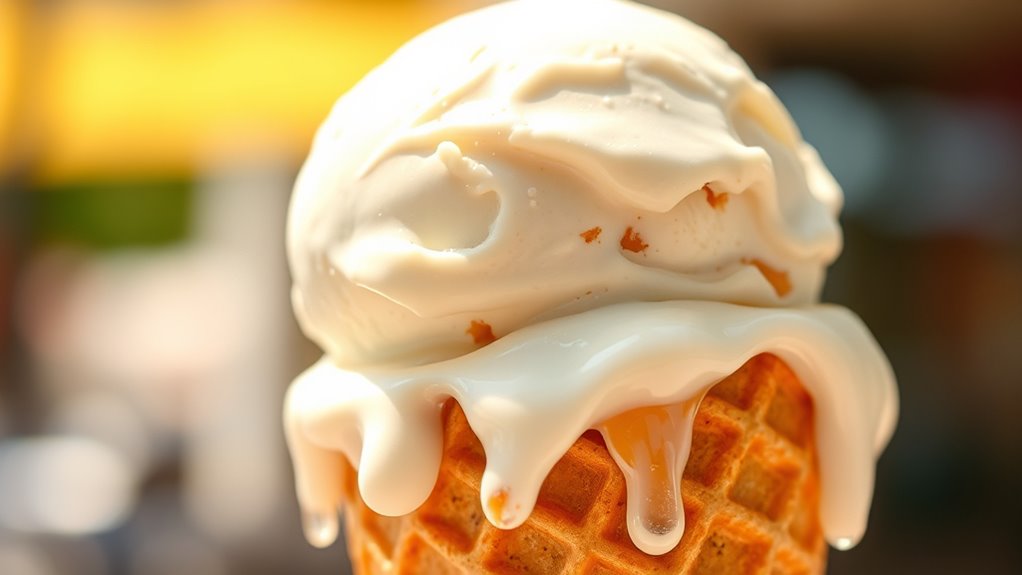

When ice cream melts, heat transfers from the surroundings into it, causing molecules to gain energy and break free from their fixed positions in the ice crystals. This process turns it into a liquid, making it drip. The rate of melting depends on how quickly heat moves through the ice cream, which is controlled by its thermal conductivity. Slowing melting involves reducing heat transfer or temperature. Keep exploring to learn more about controlling this fascinating process.
Key Takeaways
- Ice cream melts as heat transfers from warmer surroundings, breaking molecular bonds and turning solid into liquid.
- Higher thermal conductivity in ice cream allows faster heat flow, speeding up melting and dripping.
- Smaller ice crystals increase surface area, leading to quicker melting and more drips.
- Lowering the temperature reduces molecular energy, slowing heat transfer and delaying melting.
- Adding insulating layers or reducing contact with warm air can slow heat exchange and prolong melting time.

Have you ever wondered what happens at the atomic level when a solid turns into a liquid? It’s a fascinating process driven by a phase transition, where the internal structure of the material changes dramatically. When you heat ice cream, for example, you’re providing energy that excites its molecules. In a solid, these molecules are tightly packed in an organized lattice, held together by intermolecular forces. As you increase the temperature, the molecules vibrate more vigorously until they reach a point where the forces holding them in place weaken. This critical temperature marks the phase transition from solid to liquid, and it’s at this moment that the melting process begins.
During this phase change, thermal conductivity plays a vital role. Thermal conductivity measures how effectively heat moves through a material. In ice cream, the ice crystals and fat particles influence how heat travels across its structure. When heat is applied, it travels into the ice cream, raising the temperature of its molecules. The rate at which this heat spreads depends on the thermal conductivity of the mixture. If the thermal conductivity is high, heat quickly reaches the interior, accelerating melting. Conversely, if it’s low, the heat remains on the surface longer, slowing down the melting process. That’s why certain ice creams melt faster than others—it’s not just about temperature but also how well heat moves within the structure.
Thermal conductivity determines how quickly heat reaches the center, affecting how fast ice cream melts.
Once melting begins, the molecules break free from their fixed positions, changing from an ordered arrangement to a more fluid, disordered state. This shift involves absorbing a specific amount of energy called latent heat, which facilitates the phase change without increasing temperature immediately. As the solid transitions into a liquid, the molecular motion becomes less constrained, and the material’s viscosity drops, making it flow more easily. This is why ice cream drips and spreads as it melts—you’re witnessing the physical manifestation of molecules moving from a rigid lattice to a more fluid state. Additionally, the size of ice crystals influences the melting rate, with smaller crystals melting faster due to their greater surface area relative to volume.
Understanding the physics behind melt helps explain why certain conditions slow down or speed up melting. For instance, lowering the temperature reduces the energy available for molecules to overcome their bonds, delaying the phase change. Conversely, increasing thermal conductivity—by using materials that conduct heat better—can make the melting process faster. So, next time your ice cream starts to drip, remember it’s all about phase transition dynamics and how heat moves through the structure. By controlling temperature and thermal conductivity, you can influence how quickly or slowly your favorite treat melts, turning a simple snack into a fascinating display of physics in action.
Frequently Asked Questions
How Does Air Temperature Affect Ice Cream Melting Speed?
Higher air temperatures increase the ambient heat around your ice cream, making it melt faster. Humidity effects also play a role; moist air can accelerate melting by transferring heat more efficiently. When the temperature rises, your ice cream absorbs more heat quickly, causing it to melt sooner. To slow this process, keep your ice cream in a cool, shaded place and minimize exposure to warm, humid air, which speeds up melting.
What Role Does Fat Content Play in Melting Rates?
You’ll find that higher fat percentage in ice cream slows melting because fat-rich cream composition provides a more stable structure. The fat creates a barrier that reduces heat transfer, so your ice cream stays solid longer. Lower fat content melts faster, as there’s less fat to reinforce the structure. So, choosing ice cream with a higher fat percentage helps it resist melting, keeping your treat intact longer.
Can Certain Ingredients Slow Down Ice Cream Melting?
Yes, certain ingredients can slow down ice cream melting. Adding stabilizers like guar gum or xanthan gum helps maintain ingredient stability, reducing drip rates and preserving flavor longer. These ingredients create a barrier that slows heat transfer, keeping your ice cream firmer for longer. Incorporating these stabilizers guarantees your ice cream stays delicious and prevents rapid melting, giving you a better flavor experience even in warm conditions.
How Does the Shape of the Ice Cream Impact Dripping?
You’ll notice that ice cream geometry considerably impacts dripping, as the shape induces melting differently across its surface. Tall, narrow shapes concentrate heat absorption, leading to faster melting, while rounded or flat shapes distribute heat more evenly, slowing drip. By choosing shapes with larger surface areas and stable geometries, you can reduce shape-induced melting, keeping your ice cream intact longer and minimizing drips.
Does Storage Container Material Influence Melt Time?
Yes, the storage container material influences melt time. Containers with good insulation reduce heat transfer, slowing melting, while those made of high-conductivity materials like metal speed it up. Insulated containers help keep ice cream colder longer by minimizing heat absorption, whereas non-insulating ones allow heat to penetrate faster. So, choosing a container with proper insulation and low material conductivity will keep your ice cream frozen longer.
Conclusion
So, now you know the science behind why ice cream melts and how to slow it down. Remember, understanding the physics is like having the secret recipe to keep your treat from turning into a puddle. Don’t let the heat catch you off guard—stay a step ahead and keep enjoying that sweet, creamy delight. Sometimes, knowing the ins and outs lets you work smarter, not harder, ensuring your dessert stays just the way you want it.