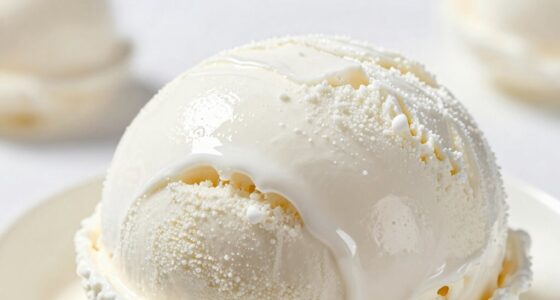
The secret to creamy ice cream lies in how fat and emulsifiers team up to create a smooth, stable texture. Fat gives ice cream its richness and luxurious mouthfeel by coating your palate and enhancing flavor. Emulsifiers, meanwhile, break down fat into tiny droplets and keep them evenly dispersed, preventing coalescence. This stable mixture resists ice crystal formation and icy textures. Keep exploring to understand how balancing these ingredients guarantees your ice cream is irresistibly smooth and velvety.

Get baking supplies delivered free — and shop member deals
- Fast, free delivery on millions of items
- Access to Prime Big Deal Days deals on October 6–7
- Prime Video, Amazon Music and more included
Key Takeaways
- Dairy fat provides a rich, smooth mouthfeel that is essential for the luxurious texture of ice cream.
- Emulsifiers break down fat into tiny droplets, ensuring a stable, uniform mixture.
- Stabilized fat droplets prevent coalescence, maintaining creaminess and preventing icy textures.
- Proper emulsification inhibits large ice crystal formation, preserving smoothness during freezing.
- The combination of high-quality fat and effective emulsification techniques results in irresistibly creamy ice cream.
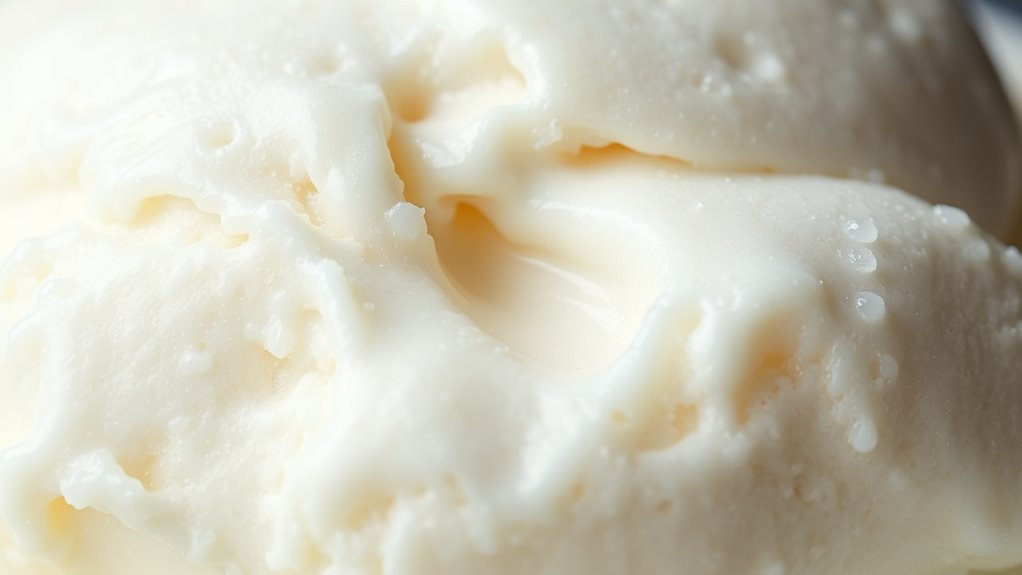
Have you ever wondered what makes ice cream irresistibly smooth and rich? The secret lies in the clever interplay of dairy fat and the emulsification process. When you enjoy that velvety texture, you’re actually experiencing the magic that happens behind the scenes. Dairy fat, found naturally in milk and cream, is essential for creating that luxurious mouthfeel. It coats your palate, giving the ice cream its creamy character and providing a rich flavor profile. But dairy fat alone isn’t enough to achieve that perfectly smooth texture. That’s where the emulsification process comes into play.
The secret to smooth, rich ice cream lies in dairy fat and emulsification.
Emulsification is the process of blending fat and water-based ingredients into a stable mixture. Since fat and water naturally repel each other, an emulsifier is needed to bind them together, creating a uniform, smooth mixture. In ice cream, emulsifiers like egg yolks or commercial stabilizers help break down the fat into tiny droplets, dispersing them evenly throughout the mixture. This creates a stable emulsion that prevents the fat from separating out as the ice cream freezes. By doing so, the emulsification process ensures the ice cream remains creamy and smooth, even after storage.
Think about how your favorite ice cream feels on your tongue. That silky sensation is a result of tiny fat droplets evenly distributed throughout the mixture. These droplets are stabilized through emulsification, which prevents them from coalescing into larger fat chunks that could ruin the texture. The smaller the fat droplets, the smoother your ice cream feels. That’s why high-quality ice creams often have a higher fat content and undergo a thorough emulsification process.
Additionally, the emulsification process influences how well the ice cream retains its texture during freezing. Without proper emulsification, ice crystals can form larger chunks, leading to a gritty or icy texture. But with a well-emulsified mixture, the fat and other ingredients work together to inhibit large ice crystal formation, maintaining that creamy consistency. This delicate balance between dairy fat and emulsifiers is what transforms simple ingredients into the decadent dessert you love.
In essence, understanding how dairy fat and the emulsification process work together reveals why some ice creams are so irresistibly smooth. It’s not just about the ingredients but how they’re combined and stabilized. When the emulsification process is executed properly, it guarantees that each spoonful delivers that luscious, creamy experience that keeps you coming back for more.
As an affiliate, we earn on qualifying purchases.
Frequently Asked Questions
Can Non-Dairy Fats Create the Same Creamy Texture?
You can achieve a creamy texture with non-dairy fats, especially using plant-based fats like coconut or avocado oils. These fats mimic dairy fat’s mouthfeel and richness. To enhance creaminess, you might also use emulsifier alternatives like lecithin or xanthan gum. While they may not perfectly replicate dairy fat, combining plant-based fats with emulsifier substitutes can produce a smooth, indulgent ice cream without dairy.
How Do Emulsifiers Prevent Ice Crystal Formation?
Ever wonder how emulsifiers effectively inhibit ice crystals in your ice cream? Emulsifier stability helps create a smooth, stable structure by surrounding fat and water molecules, preventing large ice crystals from forming. This process guarantees a silky, sumptuous texture with each scoop. By maintaining uniformity and preventing ice crystal growth, emulsifiers keep your ice cream irresistibly creamy, delivering delightful, dense decadence every time you indulge.
What Role Does Sugar Play Alongside Fats and Emulsifiers?
You might wonder what sugar does alongside fats and emulsifiers. Sugar adds sweetness, making your ice cream tasty, but it also influences texture. It helps prevent large ice crystal formation by lowering the freezing point, which keeps your ice cream smooth. Additionally, sugar can promote controlled sugar crystallization, ensuring a creamy consistency without ice crystals, working hand-in-hand with fats and emulsifiers for the perfect scoop.
Are There Natural Emulsifiers Suitable for Homemade Ice Cream?
Think of nature’s pantry as your secret weapon—there are natural emulsifiers perfect for homemade ice cream. You can use plant-based gums like guar gum or xanthan gum, which act as natural stabilizers, helping ingredients blend smoothly. These natural options keep your ice cream creamy without artificial additives. By choosing these, you guarantee a wholesome treat that’s both delicious and aligned with natural ingredients.
How Does Fat Content Influence Ice Cream Melt Rate?
You’ll notice that higher fat content slows down the melt rate of your ice cream. Fat creates a barrier that helps retain the structure and slows heat transfer, so your ice cream stays firm longer. When the fat content is lower, it melts faster because there’s less of this barrier. So, if you want your ice cream to last longer on a hot day, increasing the fat content can help you achieve that.
Conclusion
Now that you understand how fat and emulsifiers team up, your ice cream will never be the same. They’re like a dynamic duo, working together to create that irresistibly smooth, creamy texture you crave. When you make your own, remember: it’s not just about ingredients, but how they dance together in harmony. So go ahead, whip up a batch and enjoy a dessert that’s silkier than a cloud floating in a summer sky.
Evergreen bestsellers Picks
bestsellers
As an affiliate, we earn on qualifying purchases.