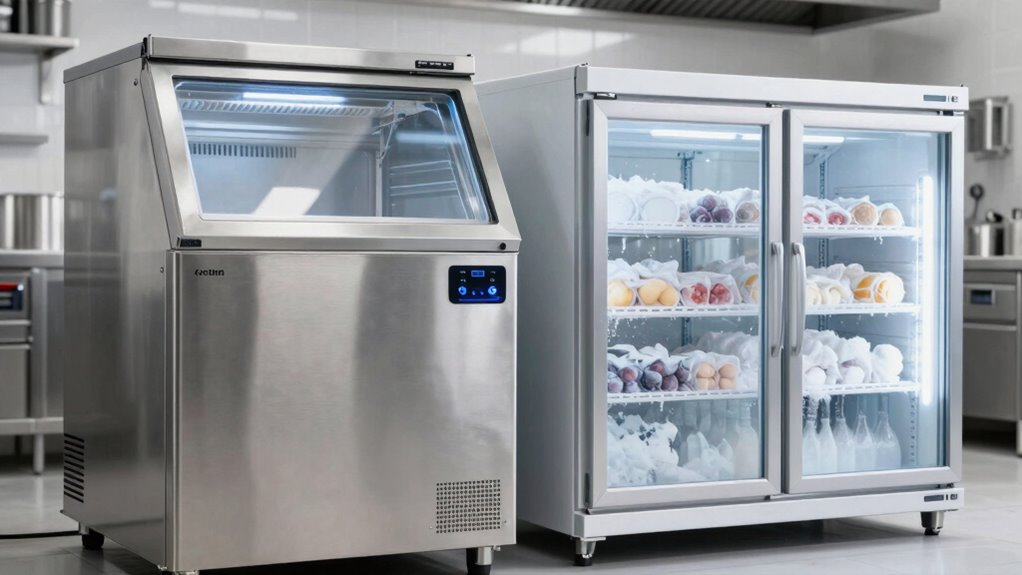
If you need to cool hot foods quickly to prevent bacteria growth and preserve texture and flavor, a blast chiller is your solution. It rapidly lowers temperatures, ideal for immediate safety and quality. If your goal is to freeze cooked or prepared foods for long-term storage, a hardening freezer is better, as it quickly solidifies foods and extends shelf life. To understand which option best fits your needs, explore more detailed differences ahead.

Get baking supplies delivered free — and shop member deals
- Fast, free delivery on millions of items
- Access to Prime Big Deal Days deals on October 6–7
- Prime Video, Amazon Music and more included
Key Takeaways
- Use a blast chiller to quickly reduce hot foods from cooking temperature to safe storage levels within 90 minutes.
- Choose a hardening freezer for rapid freezing of cooled or cooked foods to extend shelf life.
- Blast chillers address immediate food safety and quality preservation after cooking, while freezers focus on long-term storage.
- Select a blast chiller to prevent bacterial growth during rapid cooling; use a freezer for maintaining frozen state over time.
- The problem you’re solving determines whether you need rapid cooling for safety or quick freezing for preservation.

When it comes to preserving the quality and safety of perishable foods, choosing the right cooling equipment is essential. Both blast chillers and hardening freezers serve critical roles in food storage, but understanding which one best fits your needs can make a significant difference in maintaining food safety and improving energy efficiency. You might wonder, what problem am I really solving with each? The answer lies in their design and intended use, which directly impacts how quickly and safely you can cool food items.
A blast chiller is designed to rapidly lower the temperature of hot foods, typically from 140°F (60°C) down to 37°F (3°C) within 90 minutes or less. This rapid cooling process minimizes the time food spends in the temperature danger zone, where bacteria can grow rapidly. By doing so, it significantly enhances food safety, reducing the risk of foodborne illnesses. Additionally, because blast chillers cool food quickly, they help preserve the texture, flavor, and nutritional value of your dishes. Their fast cooling also means less energy is wasted on prolonged refrigeration cycles, making them relatively energy-efficient in the long run—especially when you handle large batches or need to cool hot foods regularly. Food safety is further improved by reducing the period during which bacteria can multiply. It is important to consider proper equipment selection to ensure optimal results and efficiency.
In contrast, a hardening freezer is mainly used to quickly freeze already cooled or cooked foods, turning them from a semi-liquid or soft state into a solid. It’s ideal for locking in freshness and extending shelf life, especially in large-scale food operations. While it doesn’t necessarily improve food safety in the same immediate way as a blast chiller, a hardening freezer prevents spoilage by quickly reducing temperatures, which slows bacterial growth and enzyme activity. However, because it operates at much lower temperatures over a longer period, it can consume more energy than a blast chiller, especially if not used efficiently. If your main goal is to store food for extended periods while maintaining quality, a hardening freezer is the better choice. But if you need to rapidly cool hot foods to ensure safety and quality, a blast chiller is more suitable.
commercial blast chiller for food safety
As an affiliate, we earn on qualifying purchases.
As an affiliate, we earn on qualifying purchases.
Frequently Asked Questions
How Do Blast Chillers Affect Food Texture and Quality?
Blast chillers rapidly lower food temperature, which helps preserve food quality and texture. By controlling temperature quickly, you prevent ice crystal formation that can damage cell structure, maintaining food’s freshness and appearance. This precise food preservation method guarantees that texture stays consistent, flavors remain intact, and overall quality is upheld. With effective temperature control, you get better results, reducing waste and delivering high-quality dishes to your customers.
What Is the Typical Energy Consumption Difference Between the Two?
Think of energy efficiency as a race—blast chillers generally consume less power than hardening freezers. Typically, blast chillers have lower power consumption because they rapidly cool food without maintaining a constant freezing temperature, saving energy. Hardening freezers, on the other hand, require continuous power to keep food frozen for extended periods. So, if you want to cut energy costs, a blast chiller is usually the more efficient choice.
Are There Specific Foods Best Suited for Each Device?
You’ll find that blast chillers excel at rapid food preservation and precise temperature control, making them ideal for delicate items like seafood, pastries, or cooked dishes needing quick cooling. Hardening freezers are better suited for long-term preservation of bulk items or foods requiring stable, low temperatures. Choose based on whether you need quick cooling or steady, long-term storage, ensuring ideal food quality and safety.
How Do Maintenance Requirements Compare?
Maintenance costs for blast chillers tend to be higher due to their complex systems and regular calibration needs, whereas hardening freezers generally require less maintenance. You’ll find that equipment durability varies; blast chillers often experience more wear and tear because of frequent use, but when properly maintained, both devices can last several years. Regular upkeep guarantees peak performance, so investing in routine maintenance helps reduce long-term costs and extends each unit’s lifespan.
Can Both Units Be Used for Commercial and Home Kitchens?
Both units can be used for commercial applications, but blast chillers are typically designed for professional kitchens due to their capacity and advanced features. For home use, a hardening freezer might be more practical because of size and simplicity. While you technically can use either in a home kitchen, blast chillers are better suited for high-volume, commercial settings, whereas hardening freezers suit smaller, home-style needs.
Conclusion
Choosing between a blast chiller and a hardening freezer is like picking the right brush for your masterpiece—they each shape your culinary canvas differently. The blast chiller is your swift artist, capturing freshness in a flash, while the hardening freezer is your patient sculptor, preserving textures over time. Know your needs, and you’ll wield the perfect tool, transforming everyday ingredients into culinary works of art—each one a masterpiece waiting to be discovered.
Fall Picks
fall essentials
As an affiliate, we earn on qualifying purchases.