Salt‑ice baths still work because adding salt lowers water’s freezing point, allowing the mixture to reach colder temperatures than pure ice. This phenomenon, called freezing point depression, means you can get below 32°F without the water freezing solid, making cooling faster and more efficient. The chemistry behind it explains why salt-ice mixtures can get colder and work well for quick cooling processes. If you want to understand how this old‑school method remains effective, keep exploring.

Get baking supplies delivered free with Prime
- Fast, free delivery on millions of items
- Prime Video, Amazon Music and more included
- Member-only deals all year
Key Takeaways
- Salt lowers the freezing point of water through freezing point depression, enabling colder temperatures than pure ice.
- Dissolved salt disrupts ice crystal formation, preventing water from freezing at 0°C and allowing the mixture to reach subzero temperatures.
- The salt-ice mixture accelerates phase changes, speeding up cooling and freezing processes due to thermodynamic interactions.
- Salt-ice baths maintain lower, more consistent temperatures than pure ice alone, making them effective for rapid cooling.
- The fundamental chemistry of salt and ice relies on phase transition principles, ensuring the mixture continues to freeze effectively over time.
As an affiliate, we earn on qualifying purchases.
Why Salt‑Ice Baths Still Work Today

Despite advances in cooling technology, salt-ice baths remain effective because salt lowers the freezing point of water, allowing the mixture to stay colder than pure ice alone. This relies on salt chemistry, where adding salt disrupts the process of ice formation. When you mix salt with water and ice, the salt dissolves, creating a solution that prevents water molecules from forming solid ice at the usual freezing temperature. This prevents the water from freezing solid, maintaining a colder temperature longer. The key is that salt interferes with ice formation, keeping the mixture in a liquid state even below 32°F (0°C). Additionally, the freezing point depression caused by salt enables the mixture to reach temperatures that pure ice alone cannot achieve, making salt-ice baths still practical for cooling purposes—they harness fundamental principles of salt chemistry to stay effective. The thermodynamics of salt-ice mixtures also plays a crucial role in their ongoing relevance, especially in temperature regulation techniques.
How Salt Lowers Water’s Freezing Point

Salt lowers water’s freezing point by disrupting the formation of ice crystals. This process relies on salt chemistry, where salt dissolves into water, creating a solution with different properties than pure water. When salt is added, it interferes with the hydrogen bonds that hold water molecules together in a solid state. From an ice physics perspective, this means the temperature needed for water molecules to organize into a solid structure drops. Fundamentally, the salt ions interfere with the crystal lattice, preventing ice from forming at 0°C. As a result, the solution remains liquid at lower temperatures. This principle explains why salt is effective in making ice colder than its normal freezing point, allowing for efficient cooling in salt-ice baths.
The Chemistry Behind Salt‑Ice Mixtures

The chemistry behind salt-ice mixtures hinges on how salt dissolves in water and alters its properties. When salt is added, it undergoes chemical reactions with the water molecules, disrupting their ability to form an ordered solid structure. This process affects phase changes, specifically the change from liquid water to ice. Salt interferes with the formation of ice crystals by lowering the freezing point, which is a result of the dissolved ions interfering with how water molecules bond during freezing. As a result, the mixture remains colder longer, because the salt solution requires even lower temperatures to transition back into solid ice. These chemical reactions and phase changes work together to make salt-ice mixtures effective for cooling and freezing purposes. Understanding phase changes is essential to grasping how these mixtures achieve their cooling effect.
Why Do Salt‑Ice Baths Get Cooler Than Pure Ice?
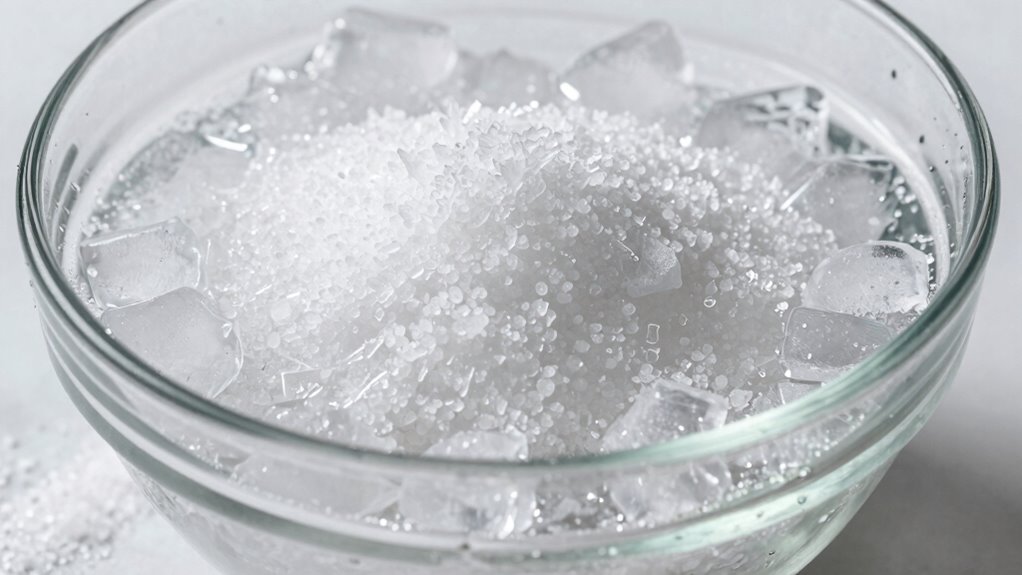
When salt is added to ice, it causes the temperature of the mixture to drop below the normal freezing point of pure water. This happens because increasing the salt concentration disrupts the formation of ice crystals, preventing water molecules from binding into solid ice at standard freezing temperatures. As salt dissolves, it lowers the equilibrium point, creating a supercooled environment where the remaining ice and water reach colder temperatures. The more salt you add, the more the ice crystal structure is compromised, allowing the mixture to get colder than pure ice alone. This process makes salt-ice baths markedly colder, enabling them to reach temperatures well below 0°C (32°F). Understanding freezing point depression is key to appreciating how this old-school science technique works, and this principle is widely utilized in various cooling applications, including temperature regulation in industrial processes. Additionally, the concentration of salt directly influences how much the freezing point is depressed, making precise control important for achieving desired temperatures.
How Salt Accelerates Freezing and Thawing in Salt‑Ice Baths

When you add salt to an ice bath, it lowers the freezing point of water, allowing the mixture to get colder than pure ice. This process speeds up how quickly the temperature drops or rises, making freezing and thawing happen faster. Understanding this helps you control temperature regulation more effectively in salt‑ice baths. Additionally, the interaction between salt and ice can influence the melting process, making it more efficient for various practical applications. The energy transfer between the salt, ice, and water is also crucial in optimizing the cooling or heating rate.
Lower Freezing Point
Ever wondered why adding salt to ice causes it to melt faster or allows ice to reach lower temperatures? It all comes down to how salt affects the freezing point. When you add salt, it increases the salinity effects, which lowers the freezing point of water. This means ice can exist at temperatures below 0°C without melting. The salt molecules interfere with water’s ability to form ice crystals, enabling colder temperatures to be reached. Here’s a quick look at how different salts influence freezing points:
| Salt Type | Freezing Point Depression | Effect Duration |
|---|---|---|
| Sodium Chloride | -1.8°C | Long-lasting |
| Calcium Chloride | -3.6°C | Faster action |
| Magnesium Chloride | -3.8°C | Moderate |
| Potassium Chloride | -1.5°C | Short-term |
| Epsom Salt | -0.5°C | Limited effect |
Additionally, the freezing point depression can be influenced by the concentration of salt, impacting how effectively the bath freezes or thaws.
Faster Temperature Change
Salt speeds up temperature changes in ice baths by disrupting the water’s equilibrium, allowing ice to melt or freeze more rapidly. This process accelerates thermal exchange, making cooling or warming quicker. Here’s how:
- Salt lowers the water’s freezing point, promoting faster melting or freezing.
- It creates a more uniform temperature, reducing hotspots and ensuring consistent cooling.
- The rapid temperature change helps preserve essential nutrients in foods or biological samples.
- Just as weather patterns influence natural temperature shifts, salt expedites artificial ones, making old-school ice baths more efficient.
- The ability of salt to modify phase transitions demonstrates the importance of thermodynamic principles in practical applications.
- Understanding phase change mechanisms enhances our ability to control temperature in various scientific and culinary processes.
- This rapid temperature adjustment is governed by phase transition mechanisms, which are central to thermodynamics.
- By controlling phase transitions, salt enables precise and rapid temperature regulation in various settings, from food preservation to scientific experiments. Additionally, the process benefits from the heat transfer properties associated with phase changes, further improving efficiency.
This quick transition is especially useful when time is limited, or precise temperature control is needed, demonstrating that salt’s role extends beyond taste to science and preservation.
Common Uses of Salt‑Ice Baths in Science and Food Preservation
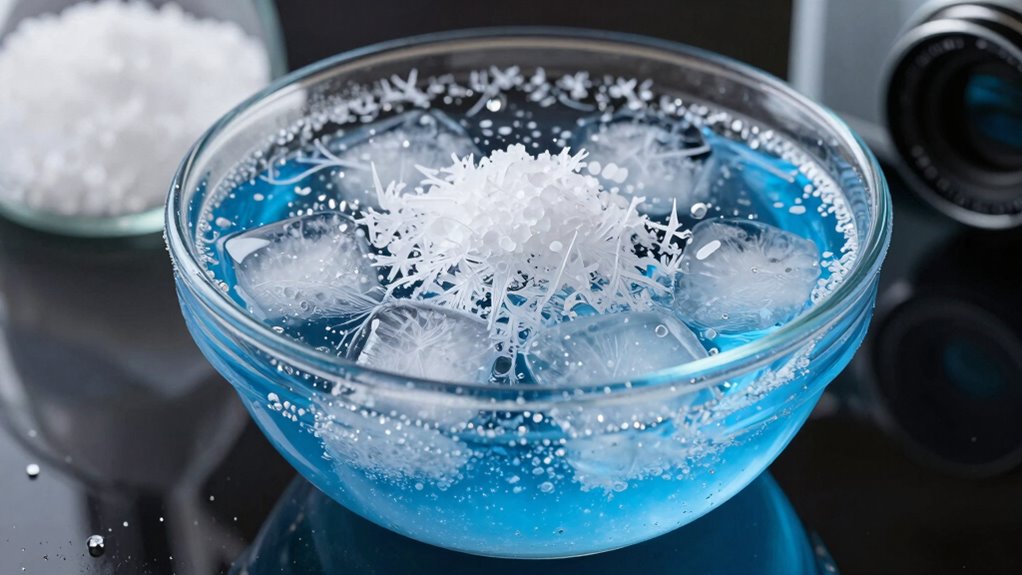
Salt-ice baths are widely used in science and food preservation due to their ability to rapidly lower temperatures and maintain a consistent cold environment. Historically, they played a vital role in early food preservation methods, helping keep perishables fresh before modern refrigeration. In scientific settings, salt-ice baths are essential for experiments requiring precise temperature control, such as protein crystallization or biological sample preservation. Their cultural significance extends to traditional food practices around the world, where salt and ice helped in curing and fermenting foods. By reliably reaching sub-zero temperatures, these baths guarantee food safety and quality, while also supporting research that depends on stable, low-temperature conditions. Their enduring utility highlights their importance across different eras and practices, especially considering the regulations governing storage of perishable items. Additionally, the chemical properties of salt enable the creation of these effective cooling solutions by depressing the freezing point of water. The cost-effectiveness of salt-ice baths also makes them accessible for various applications, from small-scale experiments to large-scale food processing. Furthermore, the ease of preparation allows for quick setup in diverse environments, making them a versatile tool in many fields. The versatility of salt-ice baths ensures their continued relevance even as new cooling technologies emerge.
What Factors Affect How Well a Salt‑Ice Bath Works?
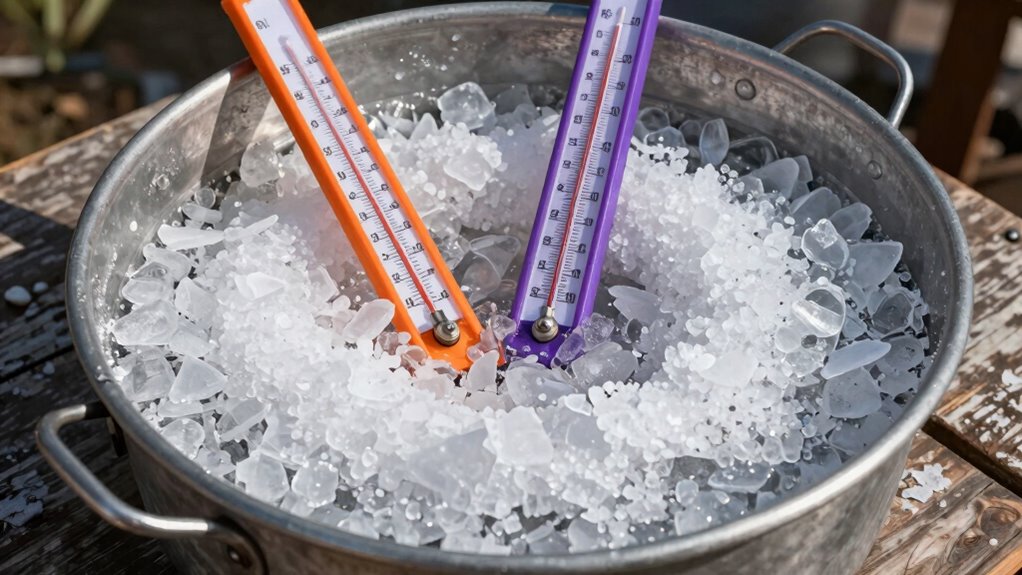
Several factors influence how effectively a salt-ice bath can reach and maintain low temperatures. First, salt distribution matters; even coverage ensures uniform cooling. If salt clumps or settles at the bottom, it reduces efficiency. Second, the container material plays a role—metal conducts cold better than plastic, promoting faster heat transfer. Third, the size and shape of the container affect circulation and temperature stability; wider or shallower containers facilitate better contact. Fourth, the initial temperature of the ingredients or items being cooled impacts how quickly they reach desired temperatures. Proper salt distribution, choosing a suitable container material, and considering container design can substantially improve your salt-ice bath’s performance. Additionally, understanding how body jewelry materials like titanium and surgical steel conduct cold can help optimize cooling processes. Paying attention to these factors helps you achieve consistent, effective freezing results.
How Temperature and Salt Concentration Influence Freezing Power
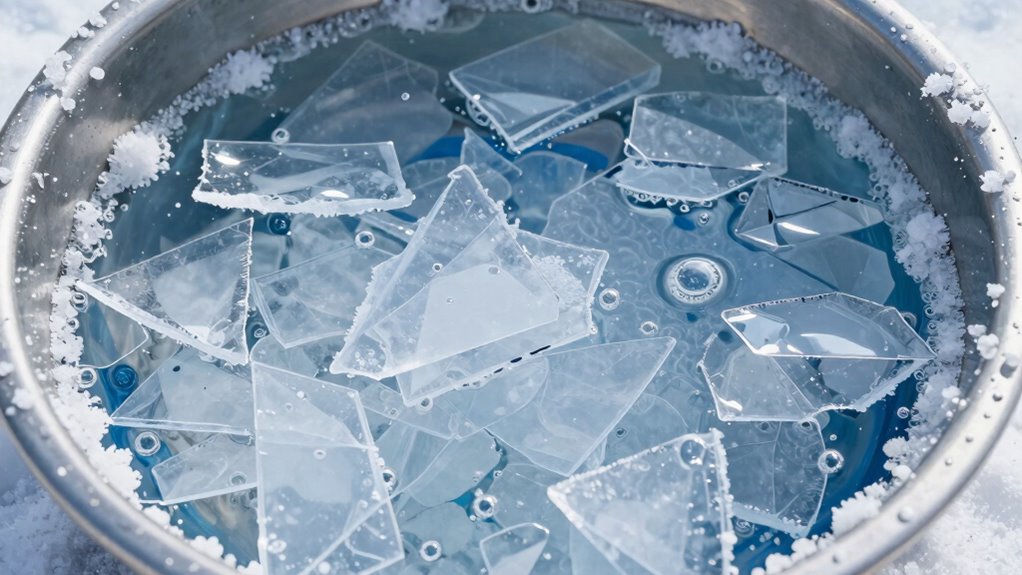
Understanding how temperature and salt concentration affect freezing power is essential for optimizing your salt-ice bath. Lower temperatures increase the bath’s ability to freeze tissues quickly, which is critical in marine biology for preserving delicate specimens. Salt concentration plays a key role: more salt lowers the freezing point, allowing colder temperatures without turning the mixture into ice. This principle is also important in climate modeling, where saltwater’s freezing behavior influences polar ice formation and ocean currents. By adjusting salt levels, you control the bath’s efficiency, ensuring it stays cold enough for effective cooling. Recognizing the relationship between temperature and salt concentration helps you fine-tune your salt-ice bath, maximizing its freezing power while understanding its relevance to natural processes like marine biology and climate systems.
How Do Salt‑Ice Baths Compare to Modern Cooling Technologies?
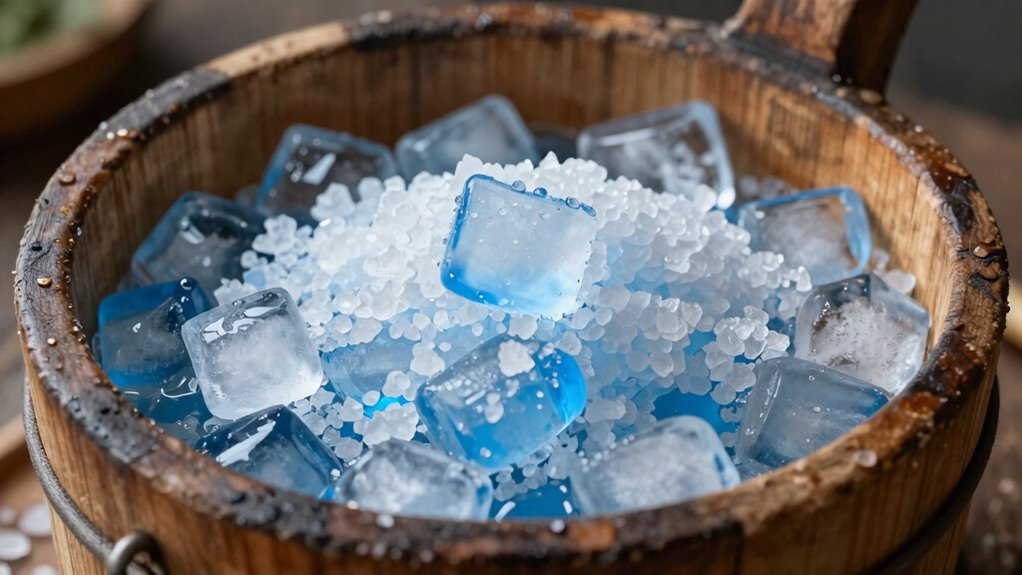
When comparing salt-ice baths to modern cooling systems, it’s important to contemplate cost and how easy they are to access. You’ll also want to look at how quickly and precisely each method can lower temperatures. Ultimately, think about the environmental impact of their materials and energy use.
Cost and Accessibility
Salt-ice baths are generally more affordable and accessible than modern cooling technologies like cryotherapy or specialized cooling devices. This makes them a practical choice for many people, offering significant cost savings and accessibility advantages.
Here’s why:
- You can create a salt-ice bath with common household items—ice, salt, and a tub—saving money on expensive equipment.
- It’s easy to set up at home, eliminating the need for specialized facilities or appointments.
- Salt lowers the freezing point, so you can use less ice, reducing ongoing costs.
- The widespread availability of ice and salt makes it accessible regardless of location or budget.
Cooling Speed and Control
While salt-ice baths are cost-effective and easy to set up, their cooling speed and level of control differ markedly from modern technologies. The phase change of ice provides a steady, predictable cooling source, but the rate depends on thermal conductivity between the bath and the item being cooled. Modern systems, like refrigerated circulators, allow precise temperature adjustments and faster cooling.
| Feature | Salt-Ice Bath | Modern Cooling Tech |
|---|---|---|
| Cooling Speed | Moderate, depends on phase change | Rapid, adjustable via controls |
| Control Precision | Limited, relies on mixing and timing | High, digital temperature control |
| Thermal Conductivity | Moderate, depends on ice and salt | Optimized for rapid heat transfer |
| Temperature Stability | Less stable, fluctuates over time | Consistent, maintains set point |
Environmental Impact
Salt-ice baths generally have a lower environmental impact compared to modern cooling systems because they use readily available, biodegradable materials and produce minimal waste. Their ecological effects are less damaging since they don’t rely on energy-intensive machinery or refrigerants that can harm the environment. Consider these points:
- They generate little to no greenhouse gases during use.
- The materials, like salt and ice, are abundant and naturally break down without polluting.
- They don’t require electricity, reducing overall carbon footprint.
- Disposal is simple and eco-friendly, unlike synthetic coolants that may leak and contaminate ecosystems.
Tips for Making an Effective Salt‑Ice Mixture

To make an effective salt-ice mixture, start by choosing high-quality coarse salt, such as rock or kosher salt, because it dissolves quickly and lowers the melting point more efficiently. Confirm the salt has minimal mineral content to avoid affecting pH balance, which can influence freezing performance. Use plenty of ice combined with the right amount of salt for rapid cooling. A well-balanced mixture creates a lower freezing point, speeding up the process.
| Tip | Why it matters |
|---|---|
| Use coarse salt | Dissolves faster, better cooling |
| Avoid mineral-heavy salt | Maintains pH balance, consistency |
| Correct salt-to-ice ratio | Ensures optimal temperature drop |
| Keep mixture cold | Prevents premature melting |
Frequently Asked Questions
Can Salt-Ice Baths Be Used for Medical Therapeutic Purposes?
Yes, salt-ice baths can be used for medical therapeutic purposes. They offer benefits like reducing inflammation and soothing sore muscles, making them useful for treatment applications such as post-exercise recovery or injury management. You might experience decreased pain and faster healing. However, it’s important to use them correctly and consult a healthcare professional to guarantee safety and maximize the medical benefits of this old-school treatment method.
What Are the Environmental Impacts of Using Salt in Ice Baths?
Using salt in ice baths can harm the environment by increasing salt runoff, which contaminates soil and water sources. This runoff can harm plants, aquatic life, and disrupt ecosystems. When you use salt in your ice bath, be mindful of its environmental impact, especially if runoff enters local waterways. Reducing salt use or opting for eco-friendly alternatives helps protect the environment from long-term damage.
How Long Can a Salt-Ice Bath Maintain Its Low Temperature?
You can expect a salt-ice bath to maintain its low temperature for about 20 to 30 minutes, but it really depends on factors like temperature stability and salt saturation. As the salt dissolves, it lowers the freezing point, prolonging cooling. Keep in mind, over time, the temperature gradually rises as the salt-saturated mixture reaches equilibrium, so quick dips are best to maximize its cold-staying power.
Are There Safety Risks Associated With Handling Salt-Ice Mixtures?
Handling salt-ice mixtures poses safety risks, so you should be cautious. You might encounter chemical hazards from the salt, which can cause skin irritation if it contacts your skin directly. Always wear gloves and protective gear to prevent skin irritation and chemical burns. Avoid ingesting or inhaling the fumes, and work in a well-ventilated area. Proper handling minimizes risks and keeps you safe during use.
How Does Salt Concentration Affect the Rate of Ice Melting?
Think of salt concentration like adding spice to a recipe; the more you add, the faster the flavor develops. Similarly, increasing salt concentration speeds up the melting rate of ice by lowering its freezing point. When you use a higher salt concentration, ice melts faster because the salt disrupts the ice’s structure more effectively. So, adjusting salt levels directly influences how quickly ice shift from solid to liquid.
Conclusion
So, next time you dip into a salt-ice bath, remember you’re tapping into a classic science trick that’s still as cool as ever. Salt lowers the water’s freezing point, creating an icy hug that’s colder than pure ice alone. It’s like Mother Nature’s own freezer, working quietly behind the scenes. Embrace this old-school method—proof that sometimes, the simplest solutions are the coolest of all. Science, after all, is a timeless recipe for success.
Halloween Picks
halloween
As an affiliate, we earn on qualifying purchases.