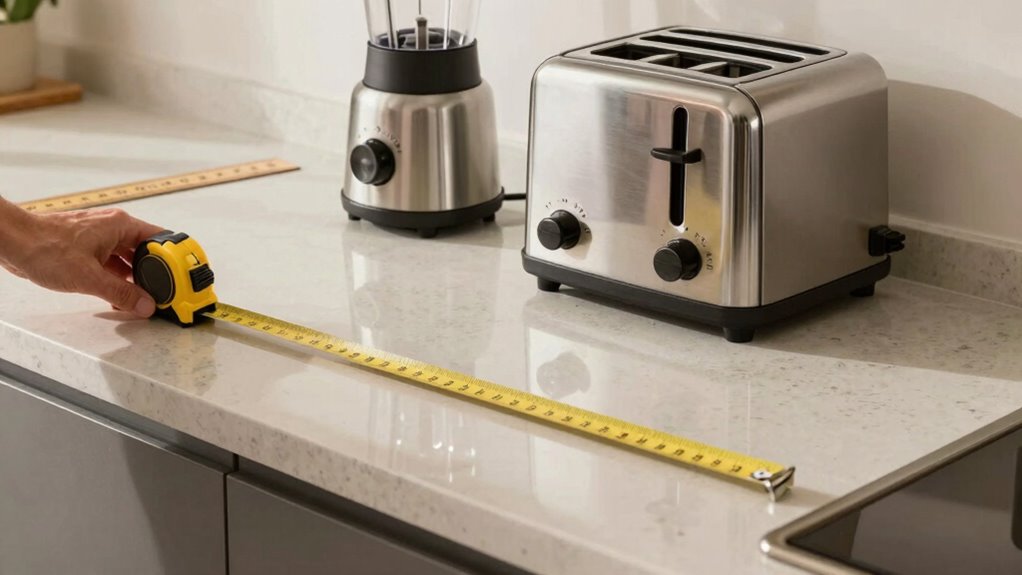

To measure counter space like a pro, start by clearing the surface and using a tape measure to record the length and width where you plan to place your appliances. Add 1-2 inches around each item for clearance and accessibility. Take note of outlet locations and any obstructions. Double-check your measurements before purchasing or arranging your appliances. Keep these tips in mind, and you’ll quickly find how to make the most of your counter space effectively.

Get baking supplies delivered free with Prime
- Fast, free delivery on millions of items
- Prime Video, Amazon Music and more included
- Member-only deals all year
Key Takeaways
- Measure each appliance’s width, depth, and height accurately using a tape measure for precise fitting.
- Add 1-2 inches of clearance around appliances for accessibility and safety.
- Record measurements in both inches and centimeters for detailed planning.
- Consider countertop thickness and edge profiles to determine true available space.
- Double-check measurements before purchasing or installing to prevent fitting issues.

When planning your kitchen layout, accurately measuring counter space is vital to make certain your appliances and preparation areas fit comfortably. Proper measurement ensures that your appliances, whether it’s a microwave, toaster, or coffee maker, can be placed conveniently without overcrowding or awkward gaps. Start by identifying the specific appliances you want to include and measure their dimensions carefully. Don’t forget to add some clearance space around each item—at least one to two inches—so they’re easy to use and accessible. This extra room prevents clutter and allows for safe operation, especially with larger appliances like stand mixers or blenders. Taking these measurements before purchasing or installing appliances guarantees a better fit, avoiding the disappointment of realizing an item doesn’t quite make it onto the countertop.
Next, consider the placement of your appliances within your kitchen’s overall layout. Think about the work triangle—your stove, sink, and refrigerator—to optimize efficiency. When measuring counter space, mark out designated zones for each appliance, ensuring there’s enough room for easy movement and workflow. Remember, appliance placement isn’t just about fitting items; it’s about creating a functional, streamlined space. For example, placing a coffee station near your breakfast nook or a toaster close to your prep area can save steps and improve your kitchen’s usability. As you measure, keep in mind any electrical outlets and wiring requirements, so appliances can be plugged in without creating clutter or hazards. Incorporating electrical safety considerations into your planning helps prevent hazards and ensures your setup is both safe and efficient.
Countertop materials also play a role in how you measure and plan your space. Different materials—granite, quartz, laminate, or butcher block—have varied thicknesses and edge profiles, which can influence how much usable surface area you actually have. When measuring, account for these factors to ensure your countertops aren’t just the right size but also accommodate the material’s dimensions. For example, thicker countertops may slightly reduce internal cabinet space or require adjustments in height. Knowing these details helps you plan not just for the appliances themselves but also for the overall aesthetic and durability of your kitchen. Proper measurement combined with an understanding of your countertop materials guarantees that your kitchen is both beautiful and functional, with appliances fitting seamlessly into your carefully planned space.
Products Worth Considering

Ninja SP101 Digital Air Fry Countertop Oven, 8-in-1, XL, Silver

Cuisinart Tabletop Propane Patio Heater, 11,000 BTU, Gray

Instant Pot RIO Wide 7.5-Quart 7-in-1 Electric Pressure Cooker
As an affiliate, we earn on qualifying purchases.
Frequently Asked Questions
How Accurate Should My Measurements Be?
Your measurements should be as accurate as possible, ideally within a quarter-inch. Precise measurement precision guarantees your appliances will fit without issues. Use reliable tools like a tape measure or ruler, and double-check your readings for consistency. Keep in mind, the more accurate your measurements, the better your planning will be, preventing surprises when you actually try to fit appliances or accessories into your counter space.
What’s the Best Tool for Measuring Counter Space?
They say, “A picture is worth a thousand words,” but in your case, precise measurements matter most. The best tool for measuring counter space is a laser distance measurer, offering quick, accurate readings with minimal effort. When comparing tools, a tape measure is versatile and affordable, while a digital caliper provides precision for small measurements. Choose based on your measuring techniques and the level of accuracy you need.
How Do I Account for Irregularly Shaped Counters?
When measuring irregularly shaped counters, you should break down the surface into manageable sections, like rectangles or triangles, and measure each part’s dimensions. Use your tape measure to note edge measurements and consider the countertop materials’ contours. Add up the measurements of all sections to get an accurate total. This method guarantees appliances fit perfectly, accounting for every nook and cranny of your unique countertop design.
Can I Measure Counter Space With Appliances in Place?
Yes, you can measure counter space with appliances in place. First, note the appliance dimensions to guarantee they fit comfortably. Then, measure the countertop clearance around each appliance, including space for ventilation and movement. Use a tape measure to get accurate readings, and consider how much space is left for other tasks. This way, you’ll know if your appliances fit well without overcrowding your counter.
How Do I Include Backsplash or Overhangs in Measurements?
Sure, include backsplash depth and overhang measurements to get an accurate space estimate—ironic, right? You just measure from the countertop edge to the farthest point of the backsplash or overhang. Don’t forget to account for any decorative overhangs or tiles that extend beyond the main surface. This way, your appliances will fit perfectly, and you won’t be caught off guard by those pesky overhangs or backsplash depths.
Conclusion
Now that you know how to measure your counter space like a pro, imagine your kitchen come to life. Picture your favorite appliances fitting perfectly, creating a sleek, organized surface that invites you to cook and gather. With your newfound precision, every inch becomes a canvas for culinary creativity. So, grab your tape measure, visualize your perfect setup, and transform your kitchen into a functional, stylish space where everything just feels right.