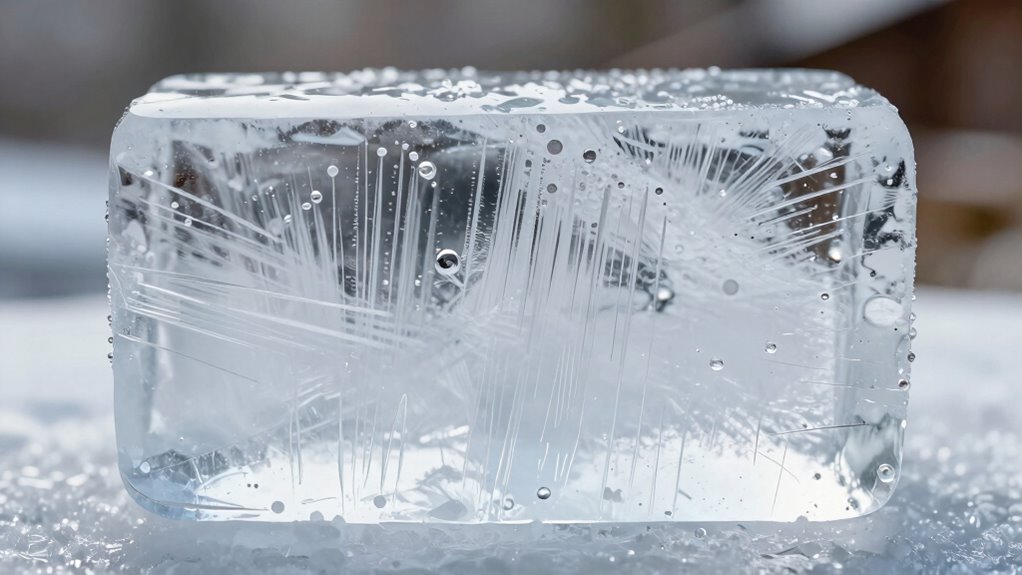

Clear ice stays transparent because it forms through a process called controlled directional freezing. This technique encourages the ice to grow crystals uniformly, pushing out impurities and air bubbles that usually make ice cloudy. By carefully managing the freezing direction and rate, you limit imperfections that scatter light. As a result, the ice becomes dense and clear. If you’re curious about how this process works in detail, there’s much more to uncover.
Key Takeaways
- Directional freezing promotes uniform crystal growth, reducing defects and impurities that cause cloudiness.
- Controlled freezing expels air bubbles and impurities, resulting in clearer, more transparent ice.
- Slow, top-down freezing encourages dense, homogeneous crystalline structures that enhance optical clarity.
- Impurities and trapped air scatter light; proper freezing minimizes these, increasing transparency.
- Factors like temperature and freezing rate influence crystal formation, directly impacting the ice’s clarity and appearance.

Have you ever wondered why some ice appears perfectly clear while other ice looks cloudy or opaque? The difference comes down to how the ice forms and the microscopic details that affect its optical properties. When ice is clear, it’s usually the result of a process called directional freezing, where water cools in a controlled manner, encouraging the formation of a uniform crystalline structure. During this process, impurities and air bubbles are pushed out of the freezing water, resulting in ice that’s transparent rather than cloudy. In contrast, irregular freezing causes impurities, trapped air, and uneven crystal growth, which scatter light and give the ice a cloudy look.
Clear ice forms through controlled directional freezing, pushing out impurities and trapping fewer air bubbles.
The optical properties of clear ice are directly influenced by how the ice crystals develop during freezing. When water freezes slowly from one direction—typically from the top down—the crystals grow in an orderly fashion, creating a dense, homogenous structure. This uniformity minimizes light scattering, allowing the ice to transmit light clearly and appear nearly transparent. Conversely, rapid or uneven freezing traps impurities and air pockets within the ice. These imperfections act as tiny scatterers, disrupting light transmission and making the ice look opaque or cloudy. The presence of these impurities not only affects how light passes through but also impacts the overall clarity and aesthetic appeal of the ice.
Understanding cloud formation helps shed light on why impurities get trapped in ice. Just like in the atmosphere, where water vapor condenses around particles to form clouds, impurities in water act as nucleation sites during freezing. When water freezes quickly or irregularly, these impurities become trapped inside the ice, rather than being expelled. This entrapment causes light to scatter in multiple directions, reducing clarity. By controlling the formation process—specifically, ensuring the ice freezes slowly and in a single direction—you allow impurities to be pushed out of the freezing front, leading to clearer, more visually appealing ice.
In essence, the science behind transparent ice hinges on controlling the formation process. By managing factors like temperature, freezing direction, and rate, you influence the crystal structure and impurity distribution within the ice. This control over the physical structure impacts the optical properties, making the difference between a cloudy, opaque block and a clear, glass-like piece of ice. So, next time you’re aiming for crystal-clear ice, remember that it’s all about guiding the formation process to produce a dense, uniform structure that minimizes light scattering and maximizes clarity.

True Cubes Crystal Clear Ice Cube Maker, 4 Large 2"x2"x2" Ice Cubes for Cocktails and Drinks, Silicone Mold for Pure, Bartender-Quality Ice – Great for Hosting and Entertaining, Whiskey Gifts for Men
- Award-Winning Clear Ice Mold: Creates perfectly clear large ice cubes
- Disappearing Clear Ice: Produces clear ice that melts slowly
- Bartenders’ Choice: Ideal for bar-quality drinks at home
As an affiliate, we earn on qualifying purchases.
As an affiliate, we earn on qualifying purchases.
Frequently Asked Questions
How Does the Shape of the Ice Mold Affect Clarity?
Your ice mold’s shape substantially impacts clarity by guiding the freezing process. A well-designed mold promotes directional freezing, pushing impurities and air bubbles away from the center, resulting in clearer ice. The freezing shape ensures uniform solidification, reducing cloudiness caused by trapped air or impurities. By choosing an appropriate ice mold, you can control the freezing shape, leading to beautifully clear, high-quality ice that enhances your drinks and presentation.
Can Impurities in Water Ever Be Completely Removed?
Impurities in water can’t be completely removed, but you can achieve very high purity levels by filtering and distilling. The mineral content and other impurities are reduced markedly, making the water much cleaner. However, trace minerals and tiny particles may still remain, especially if the water isn’t purified thoroughly. To get the clearest ice, focus on lowering impurity levels as much as possible through multiple filtration and purification steps.
Does Temperature Fluctuation Impact the Clarity of Frozen Ice?
Temperature fluctuation can profoundly impact the clarity of frozen ice. When temperatures shift rapidly, thermal conductivity varies, disrupting the controlled process of directional freezing. This causes microcrystal formation to become uneven, creating cloudy patches instead of clear, glass-like ice. You’ll notice that stable, consistent temperatures promote uniform crystal growth, resulting in clearer ice, while fluctuations foster chaos in crystal structure, making your ice cloudy and less visually appealing.
Are There Specific Water Sources That Produce Clearer Ice Naturally?
Yes, certain water sources naturally produce clearer ice. You’ll find the clearest ice from water with high quality and low mineral content, like filtered or spring water. These sources have fewer impurities and dissolved minerals that can cloud the ice. When you use water with minimal mineral content, you’ll notice the ice forms more transparently, revealing its beautiful clarity. Always opt for purified or filtered water for the best results.
How Do Commercial Ice Makers Control Freezing Direction?
Did you know that commercial ice makers control freezing direction to produce clear ice? They use specialized freezing techniques that direct ice crystal formation from top to bottom, pushing impurities downward and leaving a clear, solid block. This process involves precise temperature management and insulation, ensuring the ice freezes uniformly. By controlling the freezing direction, they prevent the formation of cloudy ice, resulting in crystal-clear cubes that are perfect for beverages.
Conclusion
By understanding how directional freezing pushes impurities out, you can make your own clear ice at home. Picture filling a cooler with water and letting it freeze slowly from top to bottom; the impurities stay behind, leaving crystal-clear ice. Just like a bartender who mastered this technique, you’ll enjoy perfectly clear cubes that not only look stunning but also melt slowly, keeping your drinks colder longer. Now, you’re ready to elevate your ice game!