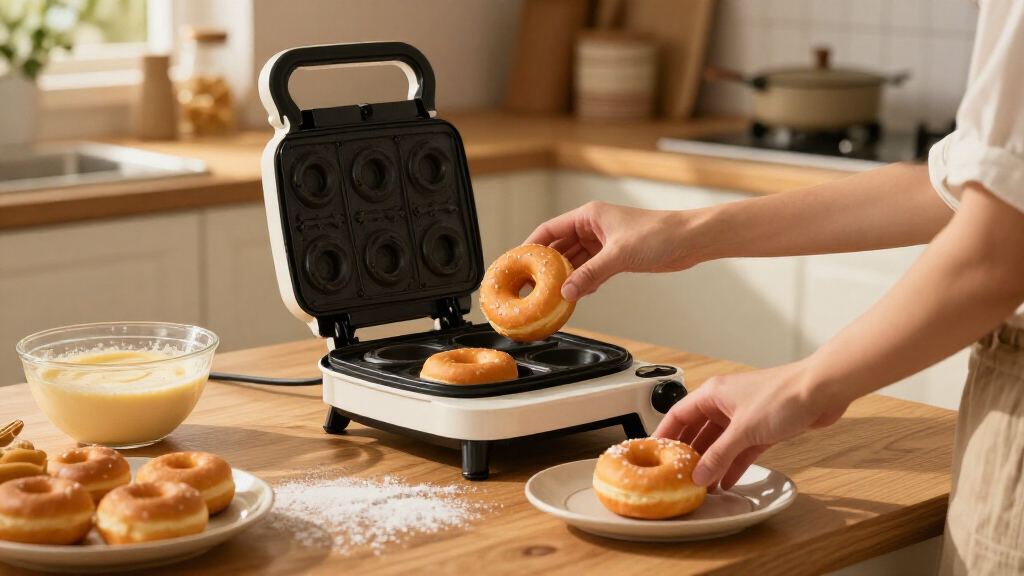

Mini donut makers range from compact countertop appliances for occasional treats to automatic machines built for high-volume service. My best overall pick is the DASH Mini Donut Maker, a straightforward choice for home batches, while the Baker’s Friend 12-Donut model offers more capacity and the VEVOR 360-donut-per-hour machine suits commercial production. The main tradeoff is simple: smaller machines take less room and suit casual use, while larger or automatic models need more space and make sense only when output matters. Slot count, cleanup, and how often you plan to make donuts can matter as much as speed. Read on for the full comparison and a guide to choosing the right style.

Get baking supplies delivered free with Prime
- Fast, free delivery on millions of items
- Prime Video, Amazon Music and more included
- Member-only deals all year
Complete the kit


Key Takeaways
- Home and commercial machines serve different jobs: countertop models make small batches for household use, while the VEVOR and FOHERE automatic machines are designed around much higher output.
- Capacity changes the rhythm of a batch: the 12- and 16-hole models can make more donuts per cycle than six- or seven-donut appliances, but a larger plate does not automatically mean faster overall cooking.
- Brand and color variants may be close comparisons: the DASH, Baker’s Friend, AshGlen, DSP, and VEVOR listings include similar or variant models, so buyers should check capacity and configuration rather than assume a different finish means a different cooking experience.
- Included accessories can help with setup, not replace core features: the JOVELL‘s mitts and oil brush add convenience, but plate capacity, handling, and cleanup matter more for repeated batches.
- The Norpro Donut Maker differs from electric countertop presses: its format may appeal to buyers seeking a simpler, hands-on option, while appliance-style models prioritize contained, repeatable batches.
| VEVOR Commercial Automatic Donut Maker, 90 Pieces per Hour |  | Best for Small-Scale Commercial Production | Model: DH-15L | Power: 3000 W | Production capacity: Up to 90 pieces per hour | VIEW LATEST PRICE | See Our Full Breakdown |
| DASH Mini Donut Maker, Makes 7 Mini Donuts |  | Best for Beginners | Model: DDM007GBDP04 | Power: 760 W | Capacity: 7 mini donuts | VIEW LATEST PRICE | See Our Full Breakdown |
| KEINVE Mini Donut Maker, 7-Slot |  | Best Compact Pick | Model: JK-156 | Capacity: 7 mini donuts | Cooking time: 4–6 minutes | VIEW LATEST PRICE | See Our Full Breakdown |
| JOVELL 16-Hole Mini Donut Maker with Oven Mitts and Oil Brush |  | Best for Bigger Home Batches | Model: DD | Capacity: 16 mini donuts per plate | Hole diameter: About 1.97 inches (5 cm) | VIEW LATEST PRICE | See Our Full Breakdown |
| Norpro Donut Maker |  | Best for Batter Versatility | Model number: 3168 | Capacity: 2 cups (16 oz / 480 ml) | Dimensions: 7 × 4 × 4 inches | VIEW LATEST PRICE | See Our Full Breakdown |
| VEVOR Commercial Automatic Donut Maker, 6 Rows, 360 Donuts per Hour |  | Best for High-Volume Production | Brand: VEVOR | Model: ZDT-6 | Capacity: Up to 360 donuts per hour | VIEW LATEST PRICE | See Our Full Breakdown |
| DASH Express Mini Donut Maker, 7 Donuts, Aqua |  | Best for Quick, Simple Batches | Brand: DASH | Type: Electric mini donut maker | Capacity: 7 mini donuts | VIEW LATEST PRICE | See Our Full Breakdown |
| Baker’s Friend Mini Donut Maker, 12-Donut Capacity |  | Best Value for Larger Home Batches | Manufacturer: Baker’s Friend | Model: BF-DM01 | Capacity: 12 mini donuts | VIEW LATEST PRICE | See Our Full Breakdown |
| Baker’s Friend Mini Donut Maker Machine (Graphite) |  | Best for Family Baking Kits | Brand: Baker’s Friend | Model: BF-DM01G | Color: Graphite | VIEW LATEST PRICE | See Our Full Breakdown |
| AshGlen Mini Donut Maker, 8 Donuts, Aqua |  | Best Compact Ceramic-Coated Pick | Brand: AshGlen | Model: AG-PMDM01A | Capacity: 8 mini donuts | VIEW LATEST PRICE | See Our Full Breakdown |
| DSP Mini Donut Maker, 6-Donut Capacity |  | Best for Quick Small Batches | Capacity: 6 donuts | Wattage: 750 watts | Voltage: 110 volts | VIEW LATEST PRICE | See Our Full Breakdown |
| AshGlen Mini Donut Maker, 8-Count, Graphite |  | Best Compact Ceramic-Coated Pick | Capacity: 8 mini donuts | Donut size: 2 inches | Coating: Ceramic nonstick | VIEW LATEST PRICE | See Our Full Breakdown |
| DSP Mini Donut Maker, 16-Hole |  | Best for High-Capacity Home Batches | Capacity: 16 donuts | Donut size: 1.93 inches | Wattage: 1400 watts | VIEW LATEST PRICE | See Our Full Breakdown |
| FOHERE Commercial Automatic 4-Row Mini Donut Maker, 1750W |  | Best for Automated Commercial Output | Power: 1750 watts | Capacity: Up to 250 donuts per hour | Hopper capacity: 3 L | VIEW LATEST PRICE | See Our Full Breakdown |
| VEVOR Commercial Automatic Donut Maker, 4 Rows, 240 Donuts per Hour |  | Best for Commercial Control and Larger Rings | Capacity: Up to 240 donuts per hour | Rows: 4 | Donut size: Approximately 50 mm diameter x 25 mm thick | VIEW LATEST PRICE | See Our Full Breakdown |
| mini donut maker | Capacity | Dimensions | Model |
|---|---|---|---|
| VEVOR Commercial Automatic Don | — | — | DH-15L |
| DASH Mini Donut Maker | 7 mini donuts | — | DDM007GBDP04 |
| KEINVE Mini Donut Maker | 7 mini donuts | 8.95 × 7.37 × 4.23 inches | JK-156 |
| JOVELL 16-Hole Mini Donut Make | 16 mini donuts per plate | 13.3 × 11.4 × 13.3 inches | DD |
| Norpro Donut Maker | 2 cups (16 oz / 480 ml) | 7 × 4 × 4 inches | — |
| VEVOR Commercial Automatic Don | Up to 360 donuts per hour | — | ZDT-6 |
| DASH Express Mini Donut Maker | 7 mini donuts | — | — |
| Baker’s Friend Mini Donut Make | 12 mini donuts | 12 × 11 × 2.75 in | BF-DM01 |
| Baker’s Friend Mini Donut Make | 12 mini donuts | — | BF-DM01G |
| AshGlen Mini Donut Maker | 8 mini donuts | — | AG-PMDM01A |
| DSP Mini Donut Maker | 6 donuts | 9 x 2.8 x 8.3 inches | — |
| AshGlen Mini Donut Maker | 8 mini donuts | 8.7 x 8.7 x 3.5 inches | — |
| DSP Mini Donut Maker | 16 donuts | 12.4 x 10.3 x 3.15 inches | — |
| FOHERE Commercial Automatic 4- | Up to 250 donuts per hour | 21.85 x 14.76 x 14.57 inches | — |
| VEVOR Commercial Automatic Don | Up to 240 donuts per hour | 21.85 x 15 x 14.5 inches | — |
More Details on Our Top Picks
VEVOR Commercial Automatic Donut Maker, 90 Pieces per Hour
For food-service buyers who need more than a countertop batch maker, the VEVOR DH-15L automates the work: it flips and counts donuts while producing up to 90 pieces per hour. Three mold sizes and adjustable thickness make it more adaptable than the home-focused DASH Mini Donut Maker, which makes seven mini donuts per batch but does not offer commercial throughput. The 5.5-liter hopper and 14.5-liter oil tank support longer production runs, while the stainless-steel construction suits a food-service setting. The tradeoff is substantial: at 61.7 pounds and over 41 inches long, it needs a dedicated, sturdy workspace. It also uses 3000 watts, so buyers should plan around its electrical and oil-handling demands rather than treating it like a plug-in home appliance.
Pros:- Automated donut flipping and counting reduce hands-on production work.
- Produces up to 90 donuts per hour for higher-volume service.
- Three mold sizes and adjustable thickness broaden the menu options.
- Large hopper and oil tank support extended production runs.
Cons:- Its 41.34-inch length and 61.7-pound weight require substantial, sturdy workspace.
- The 3000-watt power draw and 14.5-liter oil tank are a significant commitment for small operators.
Best for: Small cafés, concession operators, and food-service businesses that need automated output and multiple donut sizes.
Not ideal for: Home bakers or businesses with limited counter space, since this heavy commercial unit is far larger and more involved than the DASH or KEINVE countertop makers.
- Model:DH-15L
- Power:3000 W
- Production capacity:Up to 90 pieces per hour
- Donut sizes:Mini: 30–50 mm; standard: 55–90 mm; large: 70–120 mm
- Adjustable thickness:15–30 mm
- Hopper capacity:5.5 L
- Oil tank capacity:14.5 L
- Material:304 stainless steel
- Dimensions and weight:15.74 × 41.34 × 25.59 inches; 61.7 pounds
Our verdict“Choose the VEVOR DH-15L for a dedicated food-service setup that needs automated, adjustable production, not for casual home donut making.”
DASH Mini Donut Maker, Makes 7 Mini Donuts
The DASH Mini Donut Maker is a straightforward entry point for home bakers: it makes seven mini donuts per batch, preheats in minutes, and uses dual-sided nonstick plates to release baked donuts without the oil setup of a commercial fryer. A recipe guide and recipe database access give beginners a practical starting point, while its compact format is much easier to accommodate than the 16-donut JOVELL. That smaller batch size is the main compromise: households making treats for a crowd will need repeated rounds, and the appliance is limited to mini donuts rather than adjustable sizes. Its non-electric parts need wiping rather than a full dishwasher cleanup, so the simple design still calls for some care after baking. For occasional home batches, though, the lower complexity is a useful advantage over the VEVOR commercial machine.
Pros:- Makes seven mini donuts in one batch.
- Quick preheating helps keep occasional baking sessions moving.
- Dual-sided nonstick cooking surfaces aid release and cleanup.
- Compact design fits more readily in small home kitchens than commercial equipment.
Cons:- Small batch capacity means repeated rounds for larger groups.
- Limited to mini donuts rather than multiple sizes or shapes.
- Non-electric parts require wiping, and the product data does not specify removable cooking plates.
Best for: First-time home bakers and small households who want an easy electric appliance for occasional batches of mini donuts.
Not ideal for: Hosts who regularly bake for a crowd or buyers who want different donut sizes, since it makes only seven minis per batch and offers no size adjustment.
- Model:DDM007GBDP04
- Power:760 W
- Capacity:7 mini donuts
- Cooking surface:Dual-sided nonstick
- Included components:Mini donut maker and recipe guide
- Warranty:1-year manufacturer warranty
Our verdict“Pick the DASH for simple, small-batch home baking; choose the JOVELL if making more donuts per round matters more than a beginner-friendly format.”
KEINVE Mini Donut Maker, 7-Slot
At 8.95 × 7.37 × 4.23 inches and 2.4 pounds, the KEINVE is the most clearly documented space-saving choice in this group. It cooks seven mini donuts in 4–6 minutes, with nonstick plates intended to make release and cleanup easier. Compared with the DASH, it offers a defined cooking-time range and a notably specific compact footprint, but the provided details do not mention a recipe guide or warranty. Its seven-donut capacity also trails the JOVELL’s 16, so it suits quick household snacks better than batch baking for a party. This is an electric mini-donut appliance, not a versatile griddle: it is described for mini donuts and similar batter-based treats, and it requires a 120-volt outlet. I’d choose it when small storage needs matter more than higher output.
Pros:- Compact 8.95 × 7.37 × 4.23-inch footprint is easy to store.
- Lightweight at 2.4 pounds.
- Makes up to seven mini donuts in a stated 4–6-minute cooking window.
- Nonstick plates support easier donut release.
Cons:- Seven-donut capacity requires multiple rounds for larger groups.
- Use is limited to mini donuts and similar batter-based treats.
- Requires a 120-volt outlet, and no recipe guide or warranty is listed in the provided product details.
Best for: Apartment dwellers, students, and occasional bakers who want a lightweight seven-donut maker with a clearly stated compact footprint.
Not ideal for: Large households or party hosts who need high batch output; the JOVELL makes 16 donuts at a time, compared with KEINVE’s seven.
- Model:JK-156
- Capacity:7 mini donuts
- Cooking time:4–6 minutes
- Wattage:750 W
- Voltage:120 V
- Dimensions:8.95 × 7.37 × 4.23 inches
- Weight:2.4 pounds
- Material and finish:Metal with nonstick coating
- Included component:Instruction manual
Our verdict“Choose the KEINVE if storage space and a lightweight build are priorities; move up to the JOVELL for larger batches.”
JOVELL 16-Hole Mini Donut Maker with Oven Mitts and Oil Brush
The JOVELL’s standout advantage is straightforward: 16 mini donuts per plate means fewer rounds than the seven-donut DASH and KEINVE machines when baking for family or guests. It uses double-sided heating and lists a 1–5-minute baking time, while the nonstick surface and included oil brush support the cooking process. Mini oven mitts and a user guide round out the package. The tradeoff is a larger appliance—13.3 × 11.4 × 13.3 inches—and the product details do not mention removable or dishwasher-safe plates, which may make cleanup less convenient than buyers expect from a nonstick surface. It is still a home-oriented mini donut maker, not a flexible commercial machine like the VEVOR DH-15L, and its molds are limited to approximately 1.97-inch donuts.
Pros:- Makes 16 mini donuts per plate, reducing the number of rounds for groups.
- Double-sided heating cooks from both sides.
- Nonstick surface supports easier release.
- Includes mini oven mitts, an oil brush, and a user guide.
Cons:- Its 13.3-inch dimensions take more storage space than the DASH and KEINVE makers.
- Removable or dishwasher-safe plates are not mentioned, leaving cleanup details unclear.
- Limited to mini donuts rather than adjustable sizes or other cooking formats.
Best for: Families and home hosts who want to bake larger batches of mini donuts at once without stepping up to commercial equipment.
Not ideal for: Buyers with very limited storage or those who prioritize dishwasher-safe removable plates, since this model is larger than seven-slot alternatives and plate removal is not specified.
- Model:DD
- Capacity:16 mini donuts per plate
- Hole diameter:About 1.97 inches (5 cm)
- Power:1400 W
- Baking time:1–5 minutes
- Dimensions:13.3 × 11.4 × 13.3 inches
- Surface:Nonstick coating
- Included components:Mini donut maker, mini oven mitts, oil brush, and user guide
Our verdict“Choose the JOVELL when home-batch capacity matters most, but favor a seven-slot maker if compact storage is the priority.”
Norpro Donut Maker
The Norpro differs from every electric maker here: it is a manual batter dispenser, not a heated appliance. Its 2-cup capacity lets cooks portion batter for donuts, donut holes, funnel cakes, churros, pancakes, waffles, and crepes, making it a more flexible kitchen tool than the mini-donut-only DASH or KEINVE. That versatility comes with a clear distinction: it does not bake or fry anything by itself, so buyers still need a pan, griddle, fryer, or other cooking setup. The hand-washing recommendation also means cleanup is less hands-off than wiping down a countertop electric maker. I’d favor it for cooks who already have a cooking method and want more consistent batter dispensing across recipes, not for anyone seeking a standalone mini donut machine.
Pros:- Works with batters for donuts, donut holes, funnel cakes, churros, pancakes, waffles, and crepes.
- 2-cup capacity supports multiple portions before refilling.
- Designed to dispense batter quickly and evenly.
- Instructions and recipes are included.
Cons:- Does not cook batter, so a separate pan, fryer, griddle, or other cooking equipment is required.
- Hand washing is recommended.
- Does not provide the automated heating or batch capacity of the electric makers.
Best for: Home cooks who already own suitable cooking equipment and want one manual dispenser for several batters and foods.
Not ideal for: Buyers seeking a standalone electric donut maker that cooks a batch; unlike the DASH, KEINVE, and JOVELL, this tool only dispenses batter.
- Model number:3168
- Capacity:2 cups (16 oz / 480 ml)
- Dimensions:7 × 4 × 4 inches
- Included:Instructions and recipes
- Care:Hand washing recommended
- Manufacturer:Norpro
Our verdict“Choose the Norpro if you want a reusable batter dispenser for several recipes and already have the equipment to cook them.”
VEVOR Commercial Automatic Donut Maker, 6 Rows, 360 Donuts per Hour
For cafés, bakeries, and food stands that need output beyond countertop batches, this six-row automatic fryer is the standout in this group. Its stated capacity of up to 360 donuts per hour and automatic flipping suit sustained service better than the DASH Express or Baker’s Friend appliances, which bake only a handful of mini donuts per batch. A 4.5 L hopper and 9.1 L oil tank also mean fewer interruptions for refilling during a busy stretch. The tradeoff is substantial: at 41.2 pounds and 22 × 19.5 × 15 inches, it is commercial equipment, not a compact home treat-maker. Donuts are approximately 50 mm across, and their size can vary with batter and frying time, so buyers seeking identical results may need to tune their process.
Pros:- Automated donut flipping supports more even cooking with less hands-on work.
- Six rows and stated output of up to 360 donuts per hour suit busy service.
- Large hopper and oil tank reduce refill interruptions.
- 304 stainless steel construction is suited to frequent cleaning and commercial use.
Cons:- Its size and 41.2-pound weight make it impractical to store like a countertop mini donut maker.
- Donut size can vary depending on batter recipe and frying time.
- Produces approximately 50 mm fried ring donuts rather than the small baked batches made by home models.
Best for: Cafés, bakeries, and food stands that need automated, high-volume production of small ring donuts.
Not ideal for: Home cooks and small kitchens that lack space for a 41.2-pound commercial fryer or do not need frequent, large batches.
- Brand:VEVOR
- Model:ZDT-6
- Capacity:Up to 360 donuts per hour
- Rows:6
- Donut size:Approximately 50 mm diameter × 25 mm thick
- Hopper capacity:4.5 L
- Oil tank capacity:9.1 L
- Material and power:304 stainless steel; 1750 W; 120 V
- Dimensions and weight:22 × 19.5 × 15 in; 41.2 lb
Our verdict“Choose this VEVOR when commercial throughput and automated frying matter more than compact size or small-batch convenience.”
DASH Express Mini Donut Maker, 7 Donuts, Aqua
The DASH Express makes sense for someone who wants an uncomplicated way to bake a small batch without dedicating much kitchen space. It cooks seven mini donuts at once, and its quick heating is a practical advantage when the goal is a convenient snack rather than a long baking session. The double-sided nonstick surface helps release the donuts and cuts down on cleanup compared with equipment that requires a separate fryer and oil. Capacity is its main limit: the Baker’s Friend 12-donut maker can handle more per batch, while this DASH suits smaller households or occasional treats. It also makes mini donuts only, so it is not a substitute for a full-size donut maker. Its simple feature set favors ease and compact storage over higher output or extensive controls.
Pros:- Makes seven mini donuts in one batch.
- Heats quickly for convenient small-batch baking.
- Double-sided nonstick cooking surface helps with release and cleanup.
- Compact, lightweight design is suited to limited storage.
Cons:- Seven donuts per batch means more rounds when serving a group.
- Makes mini donuts rather than full-sized donuts.
- The supplied details do not specify dimensions or wattage for planning counter space or power use.
Best for: Small households, students, and RV owners who want a lightweight appliance for occasional batches of seven baked mini donuts.
Not ideal for: Families serving a crowd or buyers who want larger donuts, greater batch capacity, or a commercial-style fryer.
- Brand:DASH
- Type:Electric mini donut maker
- Capacity:7 mini donuts
- Color:Aqua
- Cooking surface:Double-sided nonstick
- Model number:DDM007GBAQ04
- Included components:Product and manual
Our verdict“Pick the DASH Express for quick, low-fuss mini donut batches in a small kitchen, but choose a 12-count model for more servings per round.”
Baker’s Friend Mini Donut Maker, 12-Donut Capacity
Among the home machines here, this Baker’s Friend earns its place through a straightforward benefit: 12 mini donuts per batch in a compact appliance. That is a notable step up from the seven-donut DASH Express, so it better fits family snacks or a small gathering without moving into bulky commercial equipment. Its double-sided, PFOA-free nonstick surfaces are designed to cook both sides and simplify release, while the 12 × 11-inch footprint keeps it manageable on a counter. The compromise is familiar to this appliance category: it makes mini donuts only, and you still need to prepare batter before cooking. Compared with the AshGlen eight-donut model, it prioritizes batch count over a specified ceramic coating and detailed power information.
Pros:- Makes up to 12 mini donuts per batch.
- Double-sided cooking surfaces are designed to cook donuts evenly.
- PFOA-free nonstick coating supports easier release and cleanup.
- Compact dimensions help limit counter and storage demands.
Cons:- Only makes mini donuts, not full-size rings.
- Requires batter preparation before each cooking session.
- No wattage or voltage is provided in the supplied specifications.
Best for: Families and home bakers who want to make more mini donuts per round than a seven- or eight-count appliance can handle.
Not ideal for: Buyers seeking full-size donuts, a no-prep dessert appliance, or a machine for commercial-scale production.
- Manufacturer:Baker’s Friend
- Model:BF-DM01
- Capacity:12 mini donuts
- Cooking surfaces:Double-sided nonstick
- Nonstick coating:PFOA-free
- Dimensions:12 × 11 × 2.75 in
- Weight:4.84 lb
Our verdict“Choose this Baker’s Friend for a compact home machine that turns out more donuts per round than the DASH Express or AshGlen eight-count model.”
Baker’s Friend Mini Donut Maker Machine (Graphite)
This graphite version stands out from the other 12-count home option by including a brush and recipe booklet, which gives new donut-makers a more guided starting point. Like the Baker’s Friend BF-DM01, it bakes 12 mini donuts on double-sided, PFOA-free nonstick surfaces, so its core advantage is batch capacity without a large appliance. The included accessories make it a more ready-to-start choice than the DASH Express, which lists only the product and manual. The limits are much the same as other countertop bakers: it produces bite-sized donuts rather than full-size ones, and the description says standard cake or brownie mixes work best, so experimentation with other batters may take some adjustment. Its supplied specs also omit dimensions and power details, making fit and electrical planning less certain.
Pros:- Bakes 12 bite-sized donuts per batch.
- Includes a brush and recipe booklet to support setup and cleanup.
- PFOA-free double-sided nonstick surfaces promote easier release and even cooking.
- Compact design is intended to save countertop space.
Cons:- Limited to mini-sized donuts.
- Standard cake or brownie mixes are the stated go-to batters, which may limit straightforward recipe flexibility.
- Supplied specifications do not include dimensions, weight, or wattage.
Best for: Families or first-time mini-donut bakers who value a recipe booklet and brush alongside a 12-donut batch capacity.
Not ideal for: Buyers who need full-size donuts, documented dimensions and wattage, or a machine intended for commercial service.
- Brand:Baker’s Friend
- Model:BF-DM01G
- Color:Graphite
- Capacity:12 mini donuts
- Material:Metal and plastic
- Nonstick coating:PFOA-free
- Included components:Brush and recipe booklet
Our verdict“Choose this graphite Baker’s Friend over the DASH Express if you want a larger batch and included recipe guidance, while accepting missing size and power details.”
AshGlen Mini Donut Maker, 8 Donuts, Aqua
The AshGlen is the most compactly specified home option here: at 9.45 × 9.25 inches and 2.7 pounds, it is easy to set aside when the counter needs to clear. Its ceramic-coated nonstick plates and included brush suit cooks who want an uncomplicated baked treat with less cleanup. Capacity lands between the seven-donut DASH Express and the 12-count Baker’s Friend machines, making it a reasonable middle ground for smaller batches. The tradeoff is that the donuts are only two inches across, and eight per round will mean repeat batches for a group. At 750 watts and 120 volts, it is a home appliance rather than a commercial alternative to the VEVOR. Its compactness comes with limited output, not a path to high-volume production.
Pros:- Compact 9.45 × 9.25-inch footprint and 2.7-pound weight simplify storage.
- Bakes eight two-inch mini donuts per batch.
- Ceramic nonstick plates are designed for easy release and cleanup.
- Includes a brush for cleaning.
Cons:- Two-inch donuts are small, and the machine cannot make full-size donuts.
- Eight per batch is less than the 12-donut Baker’s Friend models.
- Requires a 120 V outlet and is not suited to commercial-scale output.
Best for: Apartment dwellers and occasional bakers who want a lightweight, compact machine with ceramic-coated plates and an eight-donut batch.
Not ideal for: Large families or sellers who need higher batch capacity, full-size donuts, or commercial production.
- Brand:AshGlen
- Model:AG-PMDM01A
- Capacity:8 mini donuts
- Donut diameter:2 in
- Coating:Ceramic nonstick
- Power and voltage:750 W; 120 V
- Dimensions and weight:9.45 × 9.25 × 4.41 in; 2.7 lb
- Included components:Brush
Our verdict“Pick the AshGlen for easy storage and a modest eight-donut batch, but choose a 12-count Baker’s Friend if serving capacity matters more.”
DSP Mini Donut Maker, 6-Donut Capacity
The DSP 6-Donut Maker suits occasional batches when a short bake time matters more than high output. It makes six donuts in about three minutes, and its ready-to-bake indicator lights help keep the process simple. Compared with the AshGlen 8-Count Mini Donut Maker, it produces fewer donuts per round, but its 16-ounce listed weight makes it easier to move and store. The tradeoff is a single setting, so there is little room to adjust how it cooks, and the 110-volt requirement limits where it can be plugged in. The non-stick surface and cool-touch design support straightforward home use, though cleanup still means wiping the plates after they cool.
Pros:- Bakes six mini donuts in about three minutes
- Indicator lights signal operating readiness
- Non-stick coating supports easier cleanup
- Lightweight design is easy to store
Cons:- One setting offers little control over cooking
- Six-donut capacity means more rounds for groups
- Requires a 110-volt outlet
Best for: Occasional bakers with limited storage who want quick, small batches and simple indicator-based operation.
Not ideal for: Hosts who need more donuts per batch or cooks who want adjustable settings.
- Capacity:6 donuts
- Wattage:750 watts
- Voltage:110 volts
- Settings:1
- Dimensions:9 x 2.8 x 8.3 inches
- Weight:16 ounces
- Features:Cool-touch design, non-stick coating, indicator lights
- Warranty:1-year limited
Our verdict“Choose this compact DSP for quick, occasional six-donut batches, but pick the AshGlen 8-Count if you want more per round.”
AshGlen Mini Donut Maker, 8-Count, Graphite
The AshGlen 8-Count is a practical middle ground for home bakers: it makes two more donuts per batch than the DSP 6-Donut Maker while staying small enough for a crowded counter or cupboard. Its ceramic nonstick plates are designed to release batter easily and wipe clean after cooling, and the included brush gives you a basic cleanup tool. The eight 2-inch cavities keep the output firmly in snack-size territory, so this is not a substitute for a maker that produces larger donuts. Capacity is also modest for a gathering; the DSP 16-Hole can turn out twice as many in a batch. I’d choose the AshGlen for space-conscious households that value manageable cleanup over maximum volume.
Pros:- Makes up to eight 2-inch mini donuts per batch
- Ceramic nonstick plates are designed for easy release
- Compact 8.7-inch-square footprint
- Includes a brush for cleanup
Cons:- Eight-donut capacity may require repeated batches for groups
- Produces only mini-sized donuts
Best for: Small-kitchen households who want ceramic-coated plates and a little more batch capacity than a six-donut maker.
Not ideal for: Large gatherings or anyone who wants standard-sized donuts or more than eight per batch.
- Capacity:8 mini donuts
- Donut size:2 inches
- Coating:Ceramic nonstick
- Wattage:750 watts
- Voltage:120 volts
- Dimensions:8.7 x 8.7 x 3.5 inches
- Weight:2.7 pounds
- Included component:Brush
Our verdict“Pick the AshGlen for compact storage and an eight-donut batch; choose the DSP 16-Hole when output matters more.”
DSP Mini Donut Maker, 16-Hole
For home cooks who want to serve a crowd without moving to commercial frying equipment, the DSP 16-Hole offers a useful jump in output: it bakes 16 bite-sized donuts in about three minutes. That is double the capacity of the AshGlen 8-Count, while keeping the process closer to a countertop baking appliance than an automatic fryer. The included piping bags and kitchen tools make filling and handling batter easier, especially for someone setting up a donut-making session from scratch. The tradeoff is size: at 12.4 inches long, it takes up more storage space than the smaller DSP model, and its 1.93-inch donuts are notably bite-sized. It also needs a 110-volt outlet, so check your kitchen setup before choosing it.
Pros:- Bakes 16 donuts in about three minutes
- Includes 100 piping bags and several kitchen tools
- Cool-touch exterior and indicator lights support easier operation
- Non-stick cooking surface can be wiped clean
Cons:- Produces bite-sized donuts of about 1.93 inches
- Larger footprint than the six-donut DSP model
- Requires a 110-volt outlet
Best for: Families and party hosts who want a high-volume countertop batch and useful batter-prep accessories.
Not ideal for: Buyers short on cupboard space or those seeking larger donuts or a commercial frying workflow.
- Capacity:16 donuts
- Donut size:1.93 inches
- Wattage:1400 watts
- Voltage:110 volts
- Dimensions:12.4 x 10.3 x 3.15 inches
- Weight:2.56 kg
- Included components:100 piping bags, spatula, balloon whisk, kitchen tong, cooking brush
- Warranty:365 days
Our verdict“Choose the DSP 16-Hole for fast, generous home batches, but skip it if compact storage or larger donuts matter more.”
FOHERE Commercial Automatic 4-Row Mini Donut Maker, 1750W
The FOHERE ZDT-4 belongs in a different category from countertop baking plates: it forms, fries, flips, counts, and collects donuts automatically, with stated output of up to 250 per hour. That makes it a stronger fit for a food-service setting than the DSP 16-Hole, which bakes a single countertop batch and relies on the operator for loading and serving. Adjustable frying speed and temperature control give operators more control over production, while the 304 stainless steel construction suits repeated commercial use. The tradeoffs are substantial: this machine weighs 35.2 pounds, takes up a large footprint, and requires oil in the tank before operation. It is not a sensible pick for ordinary home snack-making, where a small electric maker is simpler to store and use.
Pros:- Automates forming, frying, flipping, counting, and collecting
- Stated production capacity of up to 250 donuts per hour
- Adjustable frying speed and temperature control
- 304 food-grade stainless steel construction
Cons:- Must have oil in the tank before operation
- Large, heavy unit is difficult to store or move
- Commercial frying setup is excessive for occasional home batches
Best for: Small food businesses, event vendors, and commercial kitchens that need automated mini-donut production.
Not ideal for: Home bakers with limited counter space or anyone who wants an oil-free, plug-in countertop appliance.
- Power:1750 watts
- Capacity:Up to 250 donuts per hour
- Hopper capacity:3 L
- Rows:4
- Donut diameter:40 mm
- Dimensions:21.85 x 14.76 x 14.57 inches
- Weight:35.2 pounds
- Material:304 food-grade stainless steel
Our verdict“Choose the FOHERE for automated high-volume service, not for the occasional batch better handled by the DSP 16-Hole.”
VEVOR Commercial Automatic Donut Maker, 4 Rows, 240 Donuts per Hour
The VEVOR 4-Row Automatic Donut Maker is aimed at operators who want automatic flipping and a control panel, but it makes a different case from the FOHERE: its listed output is up to 240 donuts per hour, compared with FOHERE’s up to 250, while its donuts are larger at about 50 mm across. The 3 L hopper and 6.1 L oil tank support sustained frying, and the smart control panel gives the operator a dedicated way to manage the machine. Its 33.1-pound weight is still far beyond a home countertop appliance, though slightly lighter than the FOHERE. Donut size can vary with recipe and frying time, so output consistency depends partly on operation. This is commercial equipment, not a convenient alternative to the DSP home makers.
Pros:- Produces up to 240 donuts per hour
- Automatic flipping supports even cooking
- Smart control panel simplifies operation
- 3 L hopper and 6.1 L oil tank suit extended production
Cons:- Donut size can vary with recipe and frying time
- Large, heavy commercial machine is not suited to compact kitchens
- Requires oil-based frying rather than simple countertop baking
Best for: Food vendors and small commercial kitchens seeking an automatic four-row fryer with a larger stated donut size.
Not ideal for: Home users, small kitchens, or buyers who need highly consistent donut dimensions without recipe and timing adjustments.
- Capacity:Up to 240 donuts per hour
- Rows:4
- Donut size:Approximately 50 mm diameter x 25 mm thick
- Hopper capacity:3 L
- Oil tank capacity:6.1 L
- Wattage:1750 W
- Voltage:120 V
- Dimensions:21.85 x 15 x 14.5 inches
- Weight:33.1 pounds
Our verdict“Pick the VEVOR for controlled commercial frying and larger rings; choose the FOHERE if its higher stated hourly output matters more.”
How We Picked
I compared these 15 mini donut makers by intended setting first: home countertop use, hands-on preparation, or commercial production. Within each group, I weighed batch capacity, stated production rate where provided, usability, practical footprint, and the likely amount of setup and cleanup. I treated listed capacity and output claims as distinctions between models, not as proof of cooking consistency or real-world speed.
The ranking favors products with a clear fit for a common buyer and a useful balance of capacity and simplicity. Home models lead because they suit the broadest group of people searching for mini donut makers; higher-capacity countertop options follow for households that want fewer rounds. Commercial automatic machines rank lower for general home use despite their output, since their scale is better suited to businesses or events. Similar models and color variants are separated by their listed capacity and configuration, while the Norpro earns a place for shoppers who prefer a different, less appliance-like approach.
Factors to Consider When Choosing Mini Donut Makers
Before choosing a mini donut maker, decide how it will fit into your kitchen routine. The headline capacity is only one part of the decision: batch frequency, storage space, cleanup, and the difference between home use and commercial production can change which design makes sense.
Match Batch Size to How You Serve
Start with the number of people you usually feed, not the largest capacity you can find. A six- or seven-donut appliance may work well when donuts are an occasional snack, while a 12- or 16-hole model can cut down the number of rounds for a group. Larger plates can also mean a wider appliance and more storage demands, so capacity has a practical cost beyond countertop space. If you expect guests, think about whether you want to serve everyone at once or are happy to cook in waves. Avoid treating a higher hole count as a guarantee of shorter total cooking time; cycle length and handling between batches matter too.
Separate Home Appliances From Commercial Machines
Commercial automatic makers with stated hourly output are built around sustained production, not casual weekend cooking. Their larger footprint, power requirements, and operating setup may be excessive for a household that makes a small batch now and then. A countertop electric model is generally easier to store and more suited to simple home routines, though it produces fewer donuts per cycle. If you are buying for a market stall, café, or frequent event service, assess the entire workflow: batter loading, finished-donut handling, cleaning, and access to power. Do not choose a commercial machine based on its output figure alone if your space or service volume cannot support it.
Think About Storage Before Plate Capacity
Mini donut makers may look compact in product listings, but appliance width, cord placement, and where the unit cools can affect whether it fits your kitchen. Measure the cabinet or shelf where you plan to keep it, then leave room to lift and open the appliance safely. A wider 12- or 16-hole plate can reduce batch count while taking up more storage space than a small seven-donut model. Commercial machines call for a separate space plan rather than an assumption that they can be put away like a countertop appliance. A common mistake is buying for peak batch size and then discovering that the unit is awkward to store between uses.
Check Cleanup and Handling Needs
Donut batter can spill around wells, hinges, and edges, so accessible surfaces and a manageable design matter after the cooking is done. Look for clear care instructions before assuming plates or parts can be submerged or placed in a dishwasher. Accessories such as an oil brush or oven mitts may make setup and handling easier, but they do not tell you how much scrubbing the appliance requires. For repeated batches, ask how you will safely remove hot donuts and where you will set them while the next cycle cooks. If a maker’s cleaning details are unclear, treat that uncertainty as part of the buying decision rather than assuming maintenance will be effortless.
Choose the Right Donut-Making Method
Electric plate-style makers suit buyers who want shaped donuts produced in a contained countertop appliance. A hands-on tool such as the Norpro may appeal to someone who prefers a more involved preparation method, but it is not automatically interchangeable with an electric maker. Consider whether you value repeatable portions and a simple appliance routine or more control over the cooking process. Also check what batter styles and preparation steps the maker’s instructions support; a donut-shaped cavity does not mean every dough behaves the same way. Buying for the method you enjoy can matter more than choosing the highest capacity.
Pay for Features You Will Use Often
More capacity, automation, and commercial construction are worthwhile only when they solve a frequent problem. For occasional household treats, a basic countertop maker may be easier to store and operate than a larger machine with unused output. If you routinely cook for a crowd, fewer batches can justify a higher-capacity design, provided you have space and a suitable workflow. For business use, compare the stated production rate with your actual service needs and the time required for batter preparation and cleanup. Color or finish alone is a weak reason to choose between similar listings; prioritize capacity, format, and care requirements instead.
Frequently Asked Questions
Is a seven-donut mini maker enough for a family?
It can be enough if donuts are an occasional snack and your household is comfortable with more than one round. A seven-donut capacity keeps each batch modest, which can suit a smaller kitchen and reduce the space needed for the appliance. For a family gathering or frequent group servings, a 12- or 16-hole model may save some repetition. Capacity alone will not tell you how quickly everyone gets served, since cooking time and handling between rounds also count. Choose based on how often you will cook for the whole household at once.
Should I buy a commercial automatic donut maker for home use?
Usually, a commercial machine is a poor fit for occasional home batches because its production scale can come with greater space and setup demands. The VEVOR and FOHERE automatic models make more sense when output is a regular need, such as a business or repeated large event service. Their stated hourly capacities are useful for comparing intended scale, but they do not replace a check of power, installation, and cleaning needs. A countertop appliance will usually be easier to accommodate for casual treats. Choose commercial equipment only when your volume justifies the added commitment.
Does a 16-hole mini donut maker always make a batch faster?
No. More holes can mean more donuts per cycle, which may reduce the number of rounds needed, but it does not establish how long each round takes. Cooking time, batter loading, removing finished donuts, and cleaning between sessions all shape the total time. A larger appliance may also take more room to set up and store. Compare the stated capacity with any available cycle or output information rather than using hole count as a speed rating. If speed is the main priority, look for clear production details that match your intended use.
Are differently colored versions of the same mini donut maker different appliances?
Not necessarily. In this lineup, some brands appear in multiple colors or closely named versions, so a different finish may not signal a meaningful change in cooking function. Check the exact model name, listed donut capacity, and configuration before choosing between variants. Do not assume that two products are identical either: the DSP listings, for example, have different stated capacities. If the listing does not spell out the differences, confirm the specifications rather than relying on product photos or color names.
What should I check before buying a mini donut maker for frequent use?
For frequent batches, prioritize capacity, practical handling, and cleaning instructions over appearance or included extras. Consider whether the appliance can stay on the counter, how you will remove hot donuts, and whether the stated output suits your serving routine. Check the maker’s care guidance so you know how to clean the plates and surrounding surfaces without damaging them. If you are preparing food for a business, factor in power, workflow, and sustained production needs before choosing a commercial model. For home use, frequent cooking may justify a larger batch size, but only if the appliance still fits your storage and cleanup routine.
Conclusion
For most home cooks, I recommend the DASH Mini Donut Maker as the best overall pick because its seven-donut format keeps the job approachable without the scale of commercial equipment. The best value choice is the KEINVE 7-Slot for shoppers who want a straightforward small-batch format; compare its listed configuration with similar seven-donut models before deciding. Beginners may prefer the DASH Express Mini Donut Maker for a simple countertop starting point. For a premium, higher-capacity home setup, consider the JOVELL 16-Hole, especially if its included mitts and oil brush suit your routine. For specific needs, choose the VEVOR 360-donut-per-hour machine or FOHERE commercial model when production volume is the priority, and the Norpro Donut Maker if you want a more hands-on alternative to an electric appliance. The right choice comes down to whether you value compact simplicity, fewer batches, or sustained output.