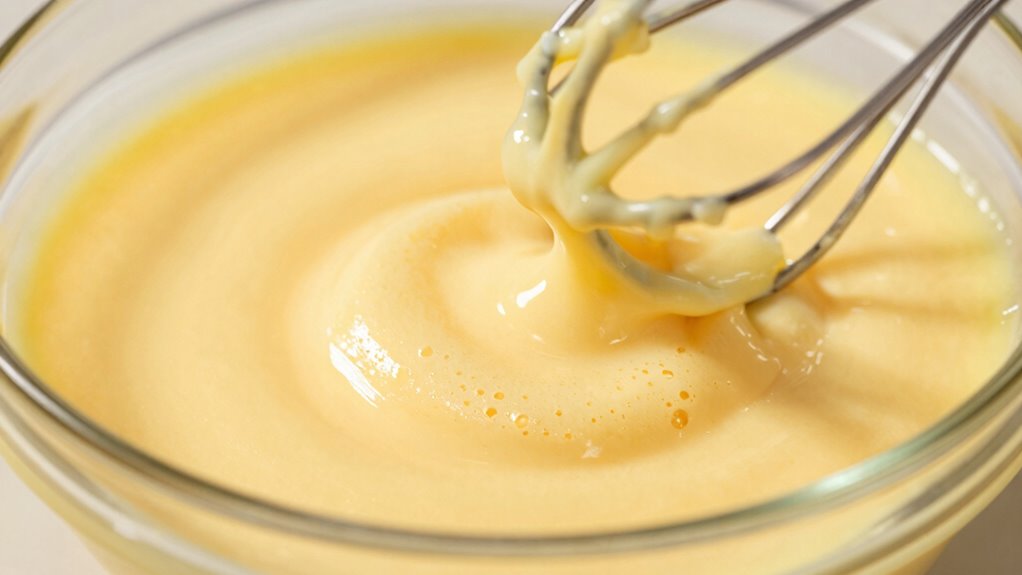

Blending a custard too long can ruin its smooth, silky texture because excessive mixing breaks down the proteins and fats too much. This causes the mixture to become thin, grainy, and unstable, often resulting in a curdled appearance. Overmixing also traps too much air, making the custard airy and rubbery. If you keep going, you’ll see how gentle stirring helps maintain the ideal consistency—there’s more to discover to get perfect custard every time.

Get baking supplies delivered free — and shop member deals
- Fast, free delivery on millions of items
- Access to Prime Big Deal Days deals on October 6–7
- Prime Video, Amazon Music and more included
Key Takeaways
- Overmixing introduces excess air, making the custard airy and unstable.
- Prolonged blending breaks down proteins, resulting in a grainy or curdled appearance.
- Excessive blending can cause the mixture to become thinner and lose its smooth, silky texture.
- Continuous blending pushes the custard past the optimal thickening point, leading to undesirable consistency.
- Using electric mixers accelerates overwhipping, increasing the risk of ruining the custard’s delicate structure.

Blending a custard for too long might seem like a quick way to achieve a smooth consistency, but it can actually sabotage the texture you’re aiming for. When you overmix, you risk altering the custard’s natural structure, leading to unintended consequences. The custard consistency relies heavily on gentle mixing; too much agitation can cause the proteins and fats to break down prematurely. This breakdown results in a thinner, more runny mixture that’s far from the creamy, velvety finish you desire. Overmixing effects are subtle but significant — what starts as a smooth base can quickly turn into a curdled or grainy mess if you’re not careful.
Think of the custard as a delicate balance between liquid and coagulated solids. When you mix too vigorously or for too long, you push the mixture past its ideal point. Instead of gently thickening, the eggs and dairy begin to whip into a froth, which affects the custard consistency negatively. This is especially true if you’re using a blender or an electric mixer, which can introduce air into the mixture. The air bubbles may cause the custard to become airy and unstable, ultimately leading to a texture that’s neither smooth nor silky. Instead, it might feel rubbery or uneven when you taste it.
The key to a perfect custard is understanding when to stop. You want enough mixing to combine ingredients thoroughly, but not so much that you force the mixture to overwhip. When you’re making custard on the stove, gentle stirring is essential, and the same principle applies when blending. Pay close attention to the appearance and feel of the mixture. Once it starts to thicken slightly and looks uniformly smooth, it’s time to stop. Overmixing effects can be avoided by using low speeds on your mixer or by hand-stirring just until the ingredients are fully incorporated. Being aware of protein breakdown is crucial, as it directly influences the custard’s final texture and consistency. Properly monitoring the mixing process helps prevent overwhipping, which can ruin the delicate texture you’re aiming for.
As an affiliate, we earn on qualifying purchases.
Frequently Asked Questions
Can Over-Blending Cause Custard to Curdle?
Yes, over-blending can cause custard to curdle by disrupting its smooth custard consistency. When you mix too aggressively or for too long, the proteins in the eggs can tighten and form lumps. Using proper mixing techniques—gentle, short bursts—helps maintain a silky texture. Pay attention to the consistency and stop blending once ingredients are just combined to avoid curdling and guarantee a smooth, luscious custard.
What Are Signs of Over-Blended Custard?
Like a delicate tapestry unraveling, an over-blended custard shows signs of instability. You’ll notice it becomes overly frothy, with a runny, uneven texture that lacks smoothness. The mixing consistency shifts from silky to “too much,” and the custard may start to curdle or develop lumps. These signs indicate that the custard’s stability is compromised, and it’s time to stop blending to preserve that perfect, creamy finish.
Does Blending Affect Custard’s Flavor?
Blending affects your custard’s flavor by enhancing ingredient integration and creating a smoother, more uniform taste. When you blend well, flavors meld seamlessly, elevating the overall experience. However, if you blend too long, it can introduce air and alter texture, which may subtly change how flavors are perceived. Keep blending just enough to combine ingredients thoroughly, and you’ll enjoy a richer, more balanced custard flavor every time.
Can Blending Improve Custard Texture?
You can improve custard consistency with the right blending techniques, but don’t go overboard, or you’ll end up with a runny mess. Gentle blending helps create a smooth, velvety texture without breaking down the delicate proteins. When you blend too long, the custard can become thin and watery. So, focus on short, controlled pulses to enhance the texture without sacrificing its richness. It’s all about striking a balance.
What Tools Are Best for Mixing Custard?
The best tools for mixing custard are a hand mixer with a whisk attachment or a sturdy whisk. A hand mixer speeds up the process and guarantees smooth blending without overworking, which can ruin the texture. The whisk attachment is perfect for incorporating ingredients gently and evenly, preventing lumps. Avoid using a spoon or fork, as they don’t provide enough aeration or consistency for a perfect custard.
Conclusion
If you blend your custard too long, you risk breaking down its delicate structure, resulting in a grainy, curdled texture. Remember, overmixing can cause the proteins to over-coagulate, ruining that smooth, silky finish you’re after. Did you know that over-blending can decrease custard quality by up to 30%? So, keep an eye on your blending time, and you’ll enjoy a perfectly creamy custard every time—no ruined textures included.
Halloween Picks
halloween
As an affiliate, we earn on qualifying purchases.