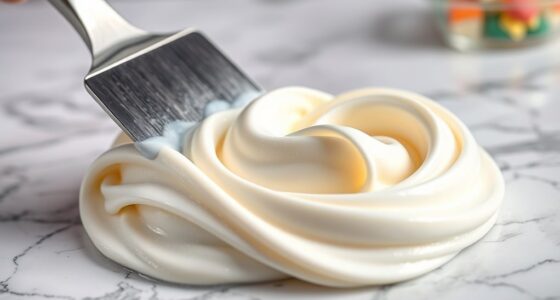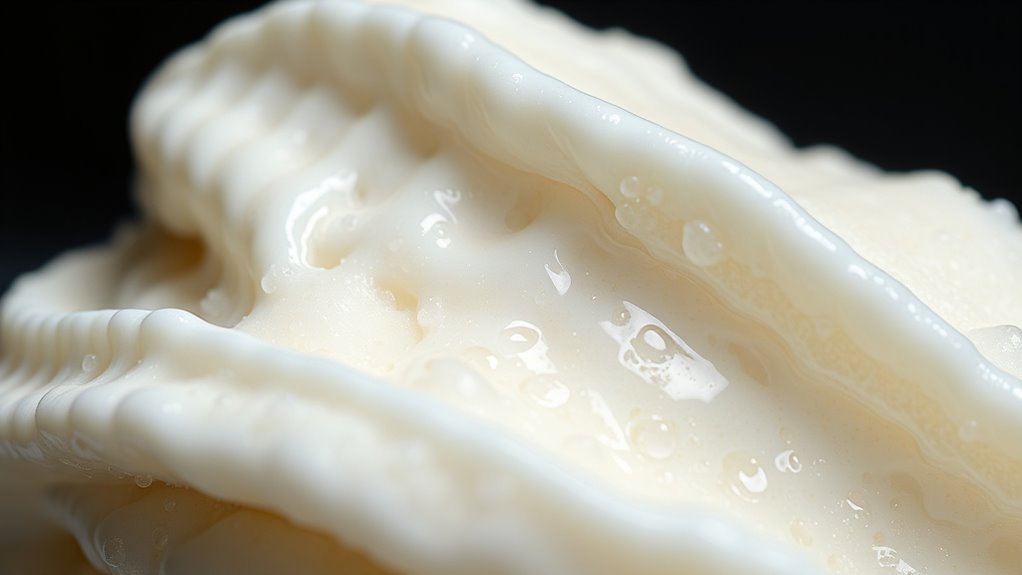

Ice cream is in-between solid and liquid because it’s a colloid, with tiny particles like fat globules and ice crystals suspended in a liquid matrix. This balance gives it a firm yet creamy texture that can easily change if the structure breaks down. When stored properly, the colloid stays stable, keeping the smooth quality you enjoy. If you want to understand how this delicate structure holds, discover more about the science behind ice cream’s texture.
Key Takeaways
- Ice cream exists in an “in-between” state, as a colloid where solid particles are suspended in a liquid matrix.
- Its creamy texture results from tiny ice crystals and fat globules stabilized within a delicate colloidal structure.
- Freeze-thaw cycles destabilize this structure, causing larger crystals and a transition toward a more solid or icy consistency.
- Stabilizers and proper storage maintain colloid integrity, preserving ice cream’s smooth, semi-solid texture.
- Understanding colloid science explains why mishandling leads to ice cream becoming grainy, icy, or watery.

Ice cream occupies a fascinating space between solid and liquid, offering a texture that’s both firm and creamy. This unique consistency results from complex interactions within its colloidal structure. When you scoop ice cream, you’re experiencing a carefully balanced system where tiny particles, like fat globules and ice crystals, are suspended in a liquid matrix. These particles form a colloid, a mixture where components do not settle out easily, giving ice cream its smooth yet solid-like feel. The stability of this colloid is vital; if it breaks down, the texture can become icy or grainy instead of creamy and uniform.
One of the key factors in maintaining colloid stability is controlling freeze-thaw cycles. When ice cream is stored, repeatedly thawing and refreezing, it destabilizes the colloid structure. During freezing, water forms ice crystals that can damage the network holding the fats and other particles together. When thawed, the structure collapses, causing larger ice crystals to form upon refreezing. These larger crystals disrupt the smooth texture you expect, resulting in ice and a loss of that creamy mouthfeel. That’s why ice cream needs consistent freezing conditions—exposure to temperature fluctuations can lead to a breakdown in colloid stability.
Understanding how freeze-thaw cycles impact colloid stability helps explain why ice cream can become icy or gritty if not stored properly. Every time it thaws, some of the delicate equilibrium between the components is disturbed. The fats and proteins that help stabilize the colloid can separate or aggregate, leading to a less desirable texture. Manufacturers work hard to minimize these effects through the use of emulsifiers and stabilizers, which help maintain the integrity of the colloid even after temperature changes. These additives act like buffers, keeping fat globules dispersed and preventing ice crystals from enlarging.
As a consumer, you might notice that ice cream stored at inconsistent temperatures can develop those unpleasant ice shards or a sandy feel. This happens because the freeze-thaw cycles have compromised the colloid stability, causing the structure to break down. To preserve its ideal texture, you should keep ice cream frozen at a steady temperature, avoiding frequent temperature swings. Proper storage ensures that the delicate balance within the colloid remains intact, allowing you to enjoy that perfect scoop—smooth, creamy, and just the right firmness. Fundamentally, understanding the science behind colloid stability and freeze-thaw cycles reveals why ice cream’s texture is so dependent on precise conditions, turning a simple treat into a marvel of food science. Maintaining proper storage conditions is crucial for preserving the colloid stability that gives ice cream its signature texture.
Frequently Asked Questions
How Does Air Incorporation Affect Ice Cream Texture?
Air incorporation introduces tiny air bubbles into ice cream, which plays a key role in shaping its texture. When you enjoy a scoop, these bubbles create a light, creamy feel, making it smoother and more enjoyable. This process enhances texture by preventing ice crystals from forming large, harsh ones. So, the more evenly air bubbles are incorporated, the creamier and fluffier your ice cream feels with each bite.
Can Ice Cream’s Structure Change Over Time?
You might notice ice cream’s structure changes over time due to phase separation and colloidal aging. These processes cause the fat, ice crystals, and stabilizers to reorganize, affecting texture and creaminess. As it ages, ice cream can become grainy or icy, losing its smoothness. Proper storage slows these changes, maintaining quality. So, yes, ice cream’s structure can evolve, impacting your eating experience over days or weeks.
What Role Do Stabilizers Play in Ice Cream Stability?
Think of stabilizers as the guardians of your ice cream’s harmony. They act like skilled architects, facilitating emulsifier functions and guiding gel network formation to keep everything together. Without them, your treat might turn chaotic, with ice crystals and separation. Stabilizers guarantee a smooth, creamy texture by maintaining stability over time, so each scoop delivers the delightful consistency you crave. They’re the silent heroes behind every perfect spoonful.
How Does Temperature Influence Ice Cream’s Colloidal Properties?
You should know that temperature affects ice cream’s colloidal properties by influencing molecular mobility and phase transitions. As temperature rises, molecules gain energy, increasing mobility and causing partial melting. This can lead to changes in texture, making it softer or less stable. Conversely, lower temperatures slow down molecular movement, maintaining structure and preventing unwanted phase transitions. Managing temperature carefully guarantees ideal consistency and prevents undesirable separation or crystallization in your ice cream.
Are There Health Benefits Linked to Ice Cream’s Colloidal Structure?
You might worry ice cream isn’t healthy, but its colloidal structure offers surprising benefits. Its nutritional advantages include better nutrient retention and easier digestion, which can support your immune system. Plus, the proteins and probiotics in some ice creams boost immune support. So, enjoying ice cream in moderation could contribute to your overall health, making it a delightful treat with hidden health perks.
Conclusion
So, next time you enjoy ice cream, remember it’s more than just a tasty treat—it’s a fascinating blend of solid and liquid states. Its unique structure keeps it creamy yet firm, a true demonstration to colloid science. As the saying goes, “Variety is the spice of life,” and ice cream perfectly embodies that. Embrace its complex nature, knowing you’re savoring a delightful masterpiece crafted through science’s magic.