
In chocolate ice cream, smaller cocoa particles create a smoother texture because they increase surface area for molecular interactions with fats and sugars, leading to a creamier feel. Higher fat content acts as an insulator, slowing heat transfer during freezing and helping prevent large ice crystals. Together, particle size and fat levels influence how the ice cream melts and tastes, shaping its overall quality. Keep exploring to discover how these factors work together behind the scenes.
Key Takeaways
- Smaller cocoa particles increase surface area, promoting uniform molecular interactions with fats and sugars for smoother texture.
- Higher fat content acts as an insulator, affecting heat transfer and controlling ice crystal formation during freezing.
- Uniform particle distribution enhances heat transfer efficiency, leading to consistent freezing and improved ice cream stability.
- Larger cocoa particles disrupt smoothness, causing gritty textures and uneven heat distribution.
- Molecular interactions between fats, sugars, and cocoa particles influence melting behavior and overall creaminess.

Chocolate ice cream might seem like a simple treat, but its creation involves fascinating physics principles. When you scoop into a bowl, you’re experiencing the result of complex molecular interactions and heat transfer processes that determine texture, flavor, and consistency. Understanding how cocoa particle size and fat content influence these elements can deepen your appreciation for this frozen delight.
Chocolate ice cream’s texture and flavor are shaped by molecular interactions and heat transfer principles.
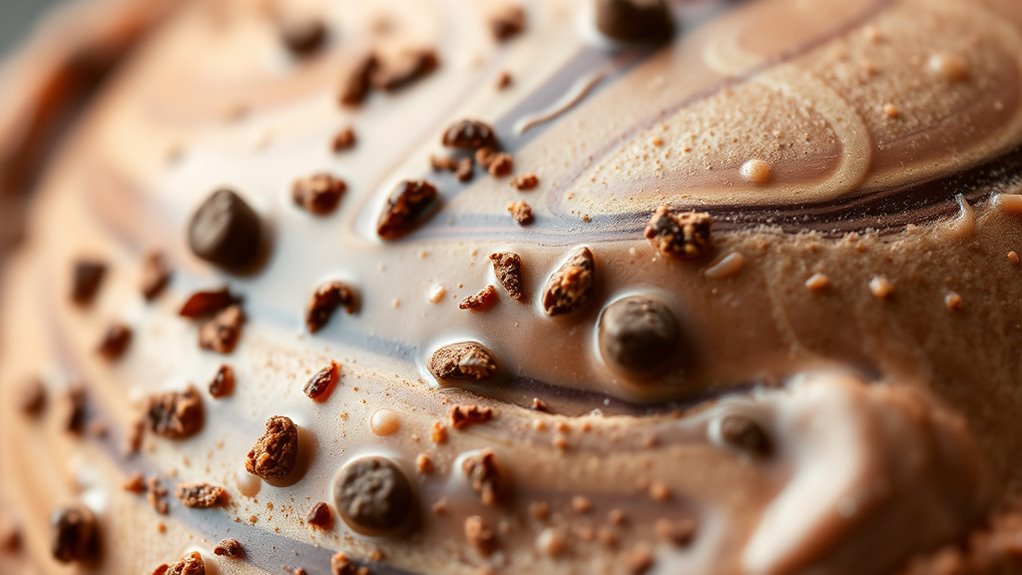
The size of cocoa particles plays a *pivotal* role in how the ice cream feels and tastes. Smaller particles increase the surface area, leading to more molecular interactions with the surrounding fats and sugars. These interactions impact how smoothly the ice cream melts and disperses in your mouth. When cocoa particles are finely ground, they form a more uniform distribution within the mixture, which results in a creamier texture. Conversely, larger particles can create a gritty sensation because they don’t interact as intimately at the molecular level. The uniformity of cocoa particles affects heat transfer during freezing and serving; smaller particles help distribute cold more evenly, reducing the formation of large ice crystals that can make the ice cream icy and less enjoyable.
Heat transfer is another fundamental physics principle at play. During freezing, heat is removed from the mixture, causing it to solidify into ice cream. The rate of heat transfer depends on several factors, including the thermal conductivity of the ingredients and the size of the particles suspended within the mixture. Smaller cocoa particles and a higher fat content can influence how heat moves through the ice cream, affecting how quickly it freezes and how stable the final product remains over time. Fat acts as an insulator, slowing heat transfer at certain points, which can lead to a smoother, more stable ice cream. Meanwhile, the fats’ melting behavior also affects how heat is absorbed when you serve the ice cream, contributing to its creamy texture as it melts in your mouth. Additionally, the molecular interactions between fats, sugars, and cocoa particles help to form a stable structure, which is essential for maintaining the desired texture and preventing the formation of large ice crystals during storage.
Frequently Asked Questions
How Does Temperature Affect Cocoa Particle Suspension Stability?
You’ll notice that as temperature increases, the thermal stability of your chocolate ice cream decreases, making cocoa particles more prone to agglomeration. Higher temperatures cause particles to clump together, destabilizing the suspension. Conversely, cooler temperatures improve stability, keeping particles evenly dispersed. So, maintaining ideal temperatures ensures your ice cream remains smooth and prevents particle agglomeration, preserving the desired texture and quality.
What Role Does Emulsification Play in Fat Distribution?
Think of emulsification as a skilled conductor guiding an orchestra. It guarantees emulsion stability by evenly dispersing fat particles throughout the mixture. Your role is to create a balanced environment where fats stay uniformly spread, preventing separation. This process enhances fat dispersion, maintaining smooth texture and rich flavor. Without proper emulsification, the fats might clump or rise, compromising the ice cream’s consistency and quality, much like a dish lacking harmony.
Can Particle Size Influence Ice Crystal Formation?
Yes, particle size can influence ice crystal formation. Smaller cocoa particles help prevent aggregation, which promotes uniform distribution and delays ice crystal nucleation. This results in a smoother texture. Larger particles, on the other hand, can act as nucleation sites, encouraging ice crystal growth. By controlling cocoa particle size, you can reduce unwanted ice crystal formation, leading to creamier ice cream and better overall mouthfeel.
How Does Mixing Speed Impact Fat and Cocoa Particle Dispersion?
Imagine a whirlwind swirling through your mixture, where mixing shear accelerates fat and cocoa particles into a seamless dance. When you increase mixing speed, you enhance dispersion uniformity, ensuring tiny particles spread evenly throughout the ice cream. This rapid, vigorous movement breaks apart clumps, creating a smooth, consistent texture. So, faster mixing delivers a more homogeneous blend, leading to better mouthfeel and flavor distribution in every spoonful.
Are There Optimal Particle Sizes for Sensory Texture?
You want the ideal particle size for sensory texture, right? Smaller cocoa particles and fat globules generally create a smoother, creamier mouthfeel, enhancing your sensory experience. If particles are too large, you might notice a gritty or grainy texture, which can detract from enjoyment. So, aiming for a fine, uniform particle size ensures your ice cream feels velvety and satisfying, elevating your overall sensory perception.
Conclusion
Understanding how cocoa particle size and fat content influence chocolate ice cream helps you appreciate its creamy texture and rich flavor. For example, reducing cocoa particles to under 20 micrometers can make the ice cream feel smoother, similar to the consistency of soft-serve. This tiny change can dramatically improve your experience, showing how science directly impacts what you taste and enjoy. Next time, you’ll see how these small details make a big difference in your favorite treat.