Emulsification is key in ice cream making because it keeps fat and water well mixed, giving you that creamy texture you love. Emulsifiers, like egg yolks and lecithin, help prevent separation while reducing ice crystal size. By accurately measuring these ingredients, you guarantee a smooth and stable mixture. This science not only enhances mouthfeel but also influences the overall quality. Discover more about how emulsifiers and stabilizers work together to elevate your ice cream experience.
Key Takeaways
- Emulsifiers, such as lecithin and mono- and diglycerides, stabilize fat and water in ice cream, enhancing texture and preventing separation.
- Homogenization reduces fat globule size, leading to smaller ice crystals and a smoother mouthfeel in the final product.
- The ideal emulsifier concentration ranges from 0.1-0.2% for regular ice cream to 0.5-0.6% for low-fat varieties.
- Balancing emulsifiers with stabilizers, like guar gum, ensures creaminess and prevents large ice crystal formation, improving overall texture.
- Innovations in emulsifiers, including plant-based options, cater to rising consumer demand for vegan and low-fat ice cream alternatives.
Understanding Emulsions in Ice Cream
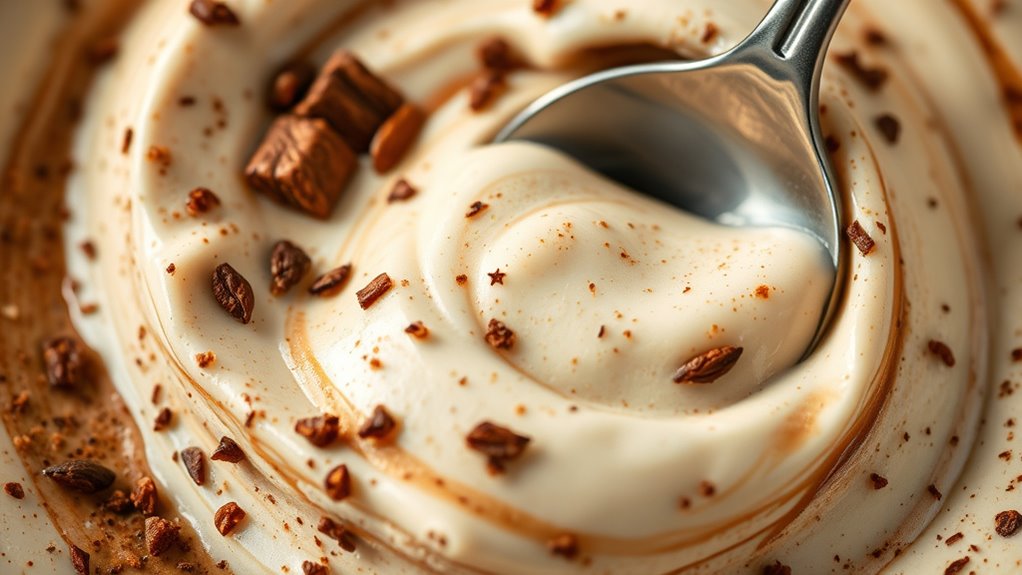
When you immerse yourself in the world of ice cream, you’ll find that emulsions play an essential role in creating that irresistible creamy texture you love.
Emulsions consist of tiny fat globules dispersed in water, preventing separation in the ice cream mix. This balance is vital for a stable emulsion, which enhances the smoothness of your treat.
Emulsions ensure tiny fat globules blend seamlessly with water, creating a smooth and stable ice cream mix.
Emulsifiers, like lecithin and mono- and diglycerides, help maintain the uniform distribution of fat and water, ensuring an even blend.
Through processes like homogenization, fat globules are reduced in size, allowing proteins to stabilize the mixture. This not only contributes to a delightful mouthfeel but also reduces ice crystal formation, giving you the perfect texture that melts beautifully in your mouth.
The Role of Emulsifiers in Achieving Creaminess

Emulsifiers play an essential role in achieving the creaminess you love in ice cream.
By stabilizing fat and water, they enhance the texture and mouthfeel, making each bite smooth and delightful.
Additionally, they help reduce ice crystal size, ensuring a more enjoyable eating experience.
Enhancing Texture and Mouthfeel
Achieving that perfect creamy texture in ice cream relies heavily on the right emulsifiers. These ingredients, like mono- and diglycerides or polysorbate 80, prevent large ice crystals from forming, ensuring a smooth and creamy mouthfeel.
By stabilizing fat molecules, emulsifiers reduce coarseness in the texture of ice cream, enhancing your overall experience. They also improve air incorporation during churning, leading to increased overrun and a lighter feel, which is essential for that desired creaminess.
Additionally, emulsifiers facilitate partial coalescence of fat globules, enhancing melting resistance. With ideal levels—0.1-0.2% for regular and 0.5-0.6% for low-fat—emulsifiers greatly boost texture, viscosity, and sensory attributes, making each scoop richer and more enjoyable.
Stabilizing Fat and Water
To create that irresistible creaminess in ice cream, stabilizing the fat and water phases is fundamental. Emulsifiers, like mono- and diglycerides, play an important role in this process. They guarantee even distribution of ingredients and prevent separation, promoting partial coalescence of fat globules.
This action contributes to a smoother texture and enhances the overall creaminess, reducing the perception of coarseness. Additionally, emulsifiers such as polysorbate 80 and lecithin increase the mix’s viscosity, aiding in uniform fat dispersion and improving mouthfeel.
Properly balancing emulsifier concentrations, typically between 0.1-0.6%, is essential for optimizing both texture and creaminess, especially in low-fat ice creams, without compromising flavor integrity.
Reducing Ice Crystal Size
While crafting ice cream, one key aspect to contemplate is how reducing ice crystal size directly impacts the creaminess of the final product.
Emulsifiers play a vital role in this process by promoting partial coalescence of fat globules, resulting in a smoother texture and eliminating graininess. Using emulsifiers like mono- and diglycerides at 0.1-0.2% enhances emulsion stability, leading to smaller ice crystals during freezing.
Additionally, these emulsifiers improve the mix’s whipping ability, allowing for more air incorporation, which contributes to a lighter texture.
Research shows that combining emulsifiers, such as polysorbate 80 and monoglycerides, effectively reduces ice crystal size and elevates creaminess, enhancing the sensory quality of your ice cream.
Common Emulsifiers Used in Ice Cream Production
Emulsifiers play an essential role in ice cream production, ensuring a smooth and creamy texture. Common emulsifiers you’ll encounter include egg yolks, soy lecithin, mono- and diglycerides, and polysorbate 80.
Egg yolks, containing natural lecithin, stabilize fat and water mixtures in custard-based ice creams at 1-2% concentration. If you prefer plant-based options, soy lecithin works effectively at 0.2-0.5% by weight without adding flavor.
Egg yolks and soy lecithin are effective emulsifiers, stabilizing fat and water in ice creams for a rich, creamy experience.
Mono- and diglycerides, which make up 70% of global emulsifier production, are typically used at 0.1-0.2% in regular ice creams and 0.5-0.6% in low-fat varieties to improve texture.
Finally, polysorbate 80, used in commercial ice creams at 0.02%-0.04%, promotes a smoother texture by facilitating fat globule clumping.
Mechanisms of Emulsification and Stability

Understanding the mechanisms behind emulsification and stability is fundamental to creating the perfect ice cream. Emulsifiers like mono- and diglycerides help disperse fat globules in water, guaranteeing a stable mixture that prevents separation. This process is imperative during the whipping process, as it promotes partial coalescence of fat globules, enhancing stability and yielding a creamy texture.
| Mechanism | Effect on Ice Cream | Importance |
|---|---|---|
| Emulsification | Prevents separation | Guarantees creamy texture |
| Stability | Reduces ice crystal formation | Maintains smoothness |
| Whipping Process | Enhances foam structure | Improves mouthfeel |
Managing temperature fluctuations is critical to avoid large ice crystals that compromise texture. Proper emulsifier concentration is essential for ideal results.
The Impact of Emulsifiers on Texture and Mouthfeel
When you indulge in a scoop of ice cream, the smooth, creamy texture you enjoy is largely due to the role of emulsifiers.
These ingredients, like mono- and diglycerides, work wonders on your experience:
- They promote a velvety mouthfeel that glides over your palate.
- Emulsifiers help reduce the size of ice crystals, making the texture less coarse.
- They enhance air incorporation, creating a light and fluffy consistency.
Sensory Evaluation of Ice Cream With Different Emulsifiers

While enjoying a bowl of ice cream, you mightn’t realize how different emulsifiers can affect your experience.
Sensory evaluation shows that emulsifiers markedly enhance the sensory quality of low-fat ice cream. For instance, polysorbate 80 blends and α-monoglycerides improve texture by reducing ice crystal size. This results in a smoother mouthfeel and creamier perception.
On the other hand, ice creams made with lecithin often receive lower flavor scores, likely due to coarser textures linked to larger ice crystals.
The right choice of emulsifier can elevate your ice cream experience, making it richer and more enjoyable. Ultimately, the balance of emulsifiers plays an essential role in achieving that perfect scoop you crave.
Balancing Emulsifiers and Stabilizers for Optimal Results

To achieve the perfect ice cream texture, you need to find the right balance between emulsifiers and stabilizers, typically around a 40/60 ratio.
This ratio not only influences the creaminess but also prevents unwanted separation.
Emulsifier-Stabilizer Ratio Importance
Achieving the perfect ice cream texture hinges on the right emulsifier-to-stabilizer ratio, as this balance directly affects the product’s stability and mouthfeel. A typical ratio of 40% emulsifiers to 60% stabilizers is recommended for ideal results.
- Emulsifiers help incorporate air, creating a light, fluffy texture.
- Stabilizers like guar gum enhance viscosity, preventing ice crystals.
- An imbalanced ratio can lead to undesirable qualities, such as a buttery texture or coarse ice cream.
In low-fat ice creams, the emulsifier-stabilizer ratio becomes even more critical, as variations can greatly impact sensory properties.
Effects on Texture Quality
Balancing emulsifiers and stabilizers is essential for ensuring your ice cream has the right texture. A typical emulsifier-to-stabilizer ratio of 40/60 is recommended for ideal results. Emulsifiers like mono- and diglycerides enhance creaminess by helping to incorporate air, while stabilizers such as guar gum and carrageenan absorb excess water, preventing ice crystal formation.
Here’s a quick look at how these components affect your ice cream:
| Component | Effect on Texture |
|---|---|
| Emulsifiers | Enhance creaminess, aid air incorporation |
| Stabilizers | Prevent ice crystals, improve mouthfeel |
| Proper Balance | Reduce coarse textures, create smoothness |
| Excess Use | Can lead to buttery texture or instability |
A well-balanced formulation leads to a creamier, more appealing product.
Measuring Ingredients Accurately
Accurate measurement of emulsifiers and stabilizers directly impacts the texture and stability of your ice cream.
When you’re measuring ingredients accurately, remember that the emulsifier-to-stabilizer ratio is key. Typically, you’ll want about 0.1-0.2% of emulsifiers necessary for regular ice cream and 0.5-0.6% for low-fat varieties.
- A smooth, creamy scoop that melts perfectly in your mouth
- A stable mixture that doesn’t separate or form ice crystals
- The ideal balance that keeps your homemade ice cream luscious and inviting
Too much emulsifier can create a buttery texture, while too little leads to instability.
Utilizing an ice cream calculator helps guarantee the accurate measurement of emulsifiers and stabilizers for the best results in your ice cream creations.
Innovations in Emulsifiers for Vegan and Low-Fat Ice Cream

As the demand for vegan and low-fat ice cream continues to rise, innovations in emulsifiers play an essential role in enhancing product quality.
You’ll find that plant-based alternatives like soy and sunflower lecithin offer effective emulsifying properties without any off-flavors. Blending mono- and diglycerides with polysorbate 80 greatly boosts the texture and stability of low-fat ice cream, improving melting resistance and mouthfeel.
Additionally, unsaturated monoglycerides help to destabilize fat globules, creating a smoother texture and smaller ice crystals. Sweet cream buttermilk has also emerged as a natural emulsifier, enhancing both emulsifying properties and sensory characteristics like creaminess.
These developments in emulsifier technology guarantee vegan and low-fat ice creams meet consumer expectations for quality and texture.
Frequently Asked Questions
What Is the Emulsification Process in Ice Cream?
The emulsification process in ice cream is all about combining fat and water to create a smooth, creamy texture.
You mix these components to prevent separation, ensuring they stay evenly distributed. Emulsifiers play a key role here, surrounding fat globules and incorporating air during whipping.
This not only lightens your ice cream but also controls ice crystal size, giving you that delightful, silky mouthfeel while enhancing stability and quality during storage.
What Is the Science Behind Emulsification?
When you stir together oil and water, you might think they’re destined to remain apart. But emulsification works its magic, creating a harmonious blend.
This science relies on emulsifiers, which act as peacemakers, surrounding fat molecules and keeping them evenly dispersed. You’ll notice how they enable air bubbles to mingle, leading to a delightful texture.
What Does Polysorbate 80 Do in Ice Cream?
Polysorbate 80’s got an essential role in ice cream. It helps you achieve a smoother texture by promoting better fat dispersion, reducing the coarseness from ice crystals.
You’ll notice a creamier mouthfeel as it stabilizes the emulsion, allowing air to mix more effectively. Plus, it maintains flavor integrity during storage, ensuring that every scoop tastes just as good as the first.
What Is the Effect of Emulsifier in Ice Cream?
Imagine taking a scoop of creamy ice cream that melts effortlessly on your tongue.
That delightful texture is thanks to emulsifiers. They work by blending fat and water, reducing ice crystal size, and ensuring a smooth, velvety mouthfeel.
You’ll notice how they enhance stability, preventing that icy crunch. With emulsifiers, your ice cream stays rich and enjoyable, making each bite a luxurious experience that’s hard to resist.
Conclusion
To sum up, understanding emulsification is key to creating luscious ice cream that delights the senses. You might think that emulsifiers compromise health, but the right ones can enhance texture without added calories. By balancing emulsifiers with stabilizers, you can achieve that creamy mouthfeel while still enjoying a guilt-free treat. So, whether you’re indulging in a classic flavor or a vegan option, remember that science plays a tasty role in every scoop!