If you’re choosing between an immersion and a countertop blender for custards and bases, consider your needs. An immersion blender offers quick, direct blending in pots, making cleanup easy and giving you control over texture. A countertop blender is more powerful, handling larger batches and dense ingredients with consistent results. Think about your batch size and cleaning preferences — for more details, keep exploring to find the best fit.
Key Takeaways
- Immersion blenders allow direct blending in pots, offering precise control and minimizing transfer messes for delicate custards.
- Countertop blenders provide more power and larger capacity, ideal for thicker bases and bigger batches.
- Immersion blenders are easier to clean with detachable shafts, suitable for quick, small-scale custard preparations.
- Countertop blenders deliver more consistent textures across larger quantities and dense ingredients.
- Your choice depends on batch size, cleaning preferences, and desired control over blending process.

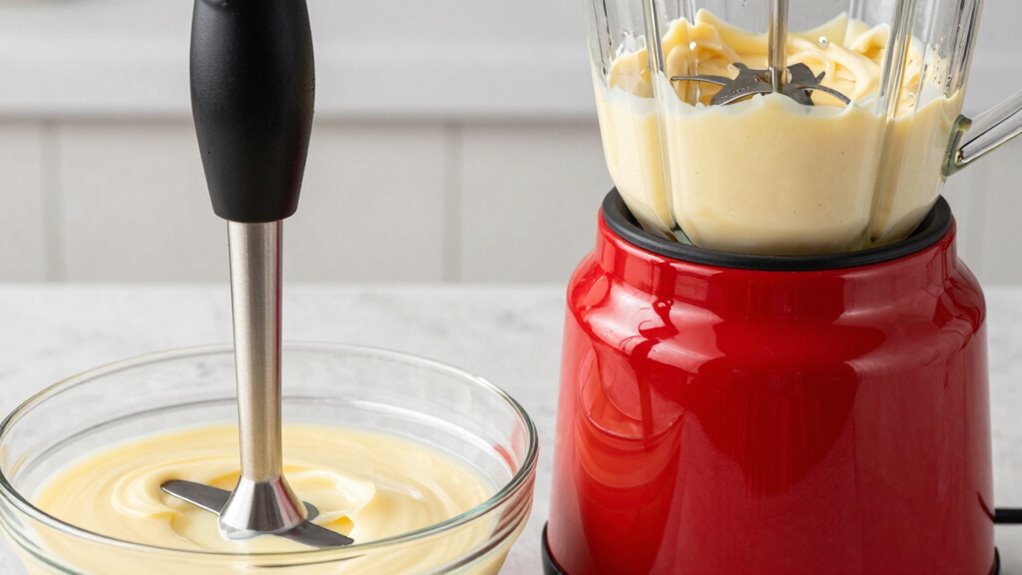
When choosing a blender, understanding the differences between an immersion blender and a countertop blender can help you make the right decision for your kitchen. Both tools serve similar purposes but excel in different ways, especially when it comes to preparing custards and bases. An immersion blender offers versatility and precision, allowing you to blend directly in the pot or bowl. This means you can achieve smooth texture consistency without transferring ingredients to another container, preserving the integrity of delicate custards and preventing splashes. Its ability to blend right in the cooking vessel minimizes the risk of over-mixing or uneven texture, giving you control over the final product’s smoothness. Plus, because it’s handheld, you can easily adjust blending speed and position, which is *vital* for getting just the right consistency.
Immersion blenders offer precise, direct blending in your cookware for smooth, delicate custards with easy cleanup.
When it comes to cleaning convenience, immersion blenders shine. Their detachable shafts can usually be rinsed under water or cleaned with a quick wipe, making cleanup fast and straightforward. You don’t need to disassemble multiple parts or wash large bowls, which can be cumbersome. This convenience is especially beneficial when working with sticky or thick custard mixtures, reducing mess and cleanup time. On the other hand, countertop blenders come with a pitcher or jar that needs cleaning after each use. While most are dishwasher safe, cleaning a large pitcher or removing stubborn residue can take more effort. If you often prepare small batches or prefer quick, minimal cleanup, an immersion blender might be more practical.
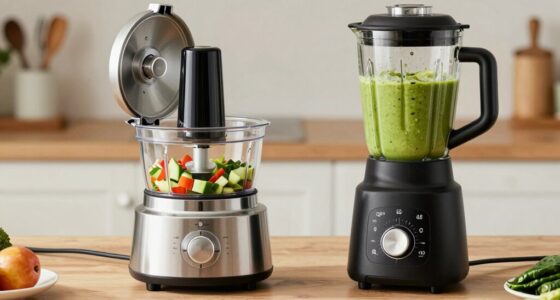
However, countertop blenders excel in certain applications, especially when you need powerful motor strength to handle thick bases or frozen ingredients. They tend to produce more uniform blends with less effort, which is *important* if you’re making custards with dense ingredients or want a consistently smooth texture. With their larger capacity, you can prepare bigger batches at once, making them ideal for families or meal prep. They also generally provide more consistent results in terms of texture, since the motor’s power and blade design are optimized for blending larger volumes evenly.
Ultimately, your choice depends on how you like to work in the kitchen. If you prioritize ease of cleaning, precision, and flexibility to blend directly in your cookware, an immersion blender is a smart option. Conversely, if you prefer a more powerful device capable of handling larger quantities and uniform textures, a countertop blender might be better suited to your needs. Both can produce excellent custards and bases, but understanding these key differences ensures you pick the right tool to suit your cooking style.
Frequently Asked Questions
Which Blender Is Easier to Clean After Making Custards?
You’ll find an immersion blender easier to clean after making custards because of its cleaning convenience. Its detachable shaft allows you to rinse or wash it quickly, leaving less residual cleanup. In contrast, a countertop blender’s jar and blades require more effort, as you need to disassemble and scrub thoroughly. Overall, immersion blenders simplify residual cleanup, saving you time and effort in the kitchen.
Can an Immersion Blender Handle Large Batches Effectively?
Think of your immersion blender as a nimble dancer on a crowded stage. It can handle small to medium batch sizes with ease, delivering quick, efficient blending. However, when faced with large batches, its performance may waver, and blending efficiency drops. For bigger quantities, a countertop blender is better suited, providing the power and capacity needed to process large batches smoothly and consistently.
Are There Safety Concerns With High-Powered Immersion Blenders?
High-powered immersion blenders can pose safety concerns if you’re not careful. Always guarantee the blade safety by keeping fingers away from moving parts, and never immerse the motor housing in water to prevent electrical safety hazards. Use the blender with dry hands and avoid overloading it, as this can cause overheating or malfunctions. Following these precautions helps you blend safely and effectively every time.
How Does the Noise Level Compare Between the Two Types?
The noise levels between an immersion blender and a countertop blender are like night and day. You’ll find immersion blenders generally produce less sound, making them a quieter choice for gentle tasks. Countertop blenders tend to be louder due to their powerful motors. For sound level comparison, immersion blenders typically operate at lower decibels, allowing you to blend comfortably without disturbing your surroundings, while countertop models can be quite the noisy powerhouse.
Which Blender Offers More Precise Control Over Blending Textures?
You’ll find a countertop blender offers more precise control over blending textures, thanks to adjustable speed settings and pre-programmed options. This enhances texture customization and guarantees blending consistency, especially for custards and bases that require specific smoothness levels. An immersion blender provides less control but excels in quick, targeted blending. If precision is key, a countertop model helps you achieve the perfect texture every time.
Conclusion
Choosing between an immersion blender and a countertop blender depends on your needs. If you prefer quick, direct blending for custards and bases, an immersion blender offers convenience. However, a countertop blender can handle larger batches and more textured blends. Notably, a 2022 survey found that 65% of home cooks prefer immersion blenders for their versatility in small kitchen tasks. Whichever you choose, both tools can elevate your cooking experience—just pick the one that fits your style best.